
Escuela de Posgrado – VI Escuela Sur-Sur
Programa de cooperación académica entre América Latina/África/Asia
Tema:
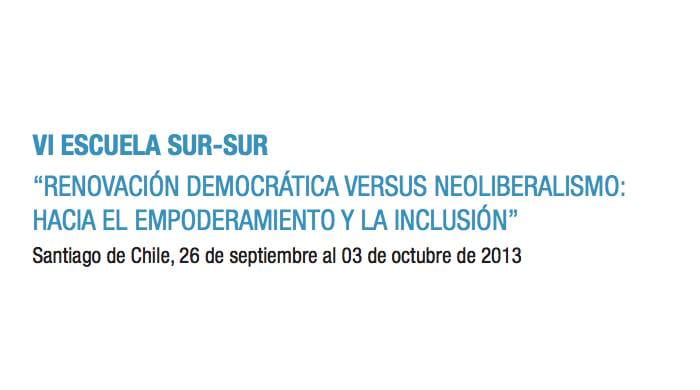
■ Renovación democrática versus neoliberalismo: hacia el empoderamiento y la inclusión
25 de septiembre al 3 de octubre de 2013 | Santiago de Chile
El Consejo Latinoamericano de Ciencias Sociales (CLACSO), el Consejo para el Desarrollo de las Ciencias Sociales en África (CODESRIA), y la Asociación Internacional de Economía del Desarrollo (IDEAS), anuncian la convocatoria para participar de la Escuela Sur-Sur «Renovación democrática versus Neoliberalismo: hacia el Empoderamiento y la Inclusión», a desarrollarse en Santiago de Chile, desde el 25 de septiembre al 2 de octubre de 2013, en el marco del tercer trienio del Programa de Cooperación Académica entre América Latina, África y Asia.
La convocatoria está abierta a jóvenes investigadores residentes en los países del Sur que estén desarrollando carreras académicas y que posean, preferentemente, título de maestría en ciencias sociales y humanidades. Serán seleccionados treinta (30) participantes, diez (10) por cada una de las tres regiones.
Consultas
En África: [email protected]
En Asia: [email protected]
SOUTH-SOUTH PROGRAM
OF TRICONTINENTAL SCHOLARLY COOPERATION BETWEEN AFRICA, ASIA, AND LATIN AMERICA
SIXTH SOUTH-SOUTH INSTITUTE
THEME: DEMOCRACTIC RENEWAL VERSUS NEOLIBERALISM: TOWARDS EMPOWERMENT AND INCLUSION
SEPTEMBER, 26 – OCTOBER, 3 2013
SANTIAGO DE CHILE
CONFERENCES
- Inaugural Conference by Jayati Ghosh (Jawaharlal Nehru University, India)
«Financial crises and women’s employment: Emerging trends and past experiences» - Final Conference by Boaventura De Sousa Santos (Universidade de Coimbra, Portugal)
«South-South Dialogue between Neocolonialism and Peoples’ Liberation»
LECTURES
- Jose Mauricio Domingues (Universidade do Estado do Rio de Janeiro, Brazil)
«Global modernity, development and social policy» - John J. Williams (University of the Western Cape, South Africa)
«Democratic Renewal Versus Neoliberalism: Towards Empowerment and Inclusion: from the global to the local: some insights from South Africa and beyond» - C.P. Chandrasekhar (Jawaharlal Nehru University, India)
«Recent Asian Development in Comparative Perspective: The End of Neoliberal Triumphalism?»
CALL FOR APPLICATION RESULTS
The evaluation of the received applications was made on a regional basis and was in charge of a Scholarly Committee composed by the following scholars, per continent:
• In Latin America
Ciska Raventós Vorst (Costa Rica)
PhD in Sociology, New School for Social Research, United States. Professor and researcher of the Institute of Social Researches, and the Center of Research and Political Studies, School of Sociology, University of Costa Rica (UCR). Among other charges, she was Director of the Institute of Social Researches (UCR) and member of the Steering Committee of the Latin American Council of Social Sciences (CLACSO), representing the Central American and the Caribbean region. He has received, among others distinctions, the award “Cátedrática Humboldt 2011”. She is author of several books and publications on socio political studies and democracy.
Eduardo Devés Valdés (Chile)
PhD in Philosophy from KU Leuven and a PhD in Latin American Studies with a specialization in History from Université Paris III. Researcher and head of the Postdoctoral Studies Program at the Institute for Advanced Studies of the Universidad de Santiago de Chile. He is a professor of the Doctorate in American Studies and the Masters in International Studies at the Universidad de Santiago de Chile. He has published over 150 works on eidetic studies, Latin American thought, the thought of peripheral regions, and intellectual networks.
Livio Sansone (Brazil)
PhD in Anthropology, Universiteit van Amsterdam. Anthropology professor at the Federal University of Bahia (Brazil) and researcher at the Center of Afro-Oriental Studies (FFCH/UFBA), where coordinates the “Fábrica de Idéias” Program and integrates the Post-graduation Multidisciplinary Program on Ethnical and African Studies. Among other scholarly and directive charges, he was researcher of the Institute of Migration and Ethnical Studies, Universiteit van Amsterdam; and scientific vice-director of the Centre of Afro-Asian Studies at the Candido Mendes University (Brazil). He is member of the editorial councils of various scholarly journals and author of numerous publications.
• In Africa
Jibrin Ibrahim (Nigeria)
PhD in Political Science from the Institut d’Etudes Politiques in Bordeaux, France. Director of Centre for Democracy and Development, a non-governmental organization for West Africa. He is also presently serving on the Electoral Reform Committee established by President Umaru Yar Adua. He was Nigeria Country Director of Global Rights and he was the National Convenor of the Citizen’s Forum for Constitutional Reform (a coalition of Ninety non-governmental organizations seeking to reform the 1999 Nigerian Constitution). His areas of specialization are democratization, political economy of poverty reduction, comparative federalism and religious and ethnic identities.
Karuti Kanyinga (Kenia)
Ph.D. in Social Sciences, International Development Studies (IDS), Roskilde University, Denmark. Karuti Kanyinga is an accomplished development researcher and scholar and has carried out many research programs and projects at the Institute for Development Studies (IDS), University of Nairobi, in the last 20 years. He has published extensively on development and governance in Kenya and is renowned for his contributions to scholarship and knowledge in governance and development. Karuti is renowned particularly for his extensive research and publications on land rights in Kenya; civil society and development; ethnicity and development; and electoral politics and development.
• In Asia
Jayati Ghosh (India)
PhD at Cambridge University, England. She is Professor at the Centre for Economic Studies and Planning, School of Social Sciences, Jawaharlal Nehru University, New Delhi, and the Executive Secretary of International Development Economics Associates (IDEAs). Her research areas include globalization, international finance, employment patterns in developing countries, macroeconomic policy, and issues related to gender and development. She writes regular columns on economics and current affairs for the Guardian, Frontline magazine, Businessline, the Bengali newspaper Ganashakti, Deccan Chronicle, and Asian Age. Among other awards, she is co-recipient of the International Labour Organisation’s 2010 Decent Work Research prize.
C. P. Chandrasekhar (India)
Professor at the Centre for Economic Studies and Planning, Jawaharlal Nehru University. He has taught at the Centre for Development Studies, Trivandrum and the School of Oriental and African Studies, University of London. His areas of interest include the role of finance and industry in development and the experience with fiscal, financial and industrial policy reform in developing countries. He publishes in journal and books in India and abroad. He is a regular columnist for Frontline (titled Economic Perspectives), Business Line (titled Macroscan), The Hindu web edition (titled Economy Watch) and the Triple Crisis blog. He is also a member of the Executive Committee of the International Development Economics Associates (IDEAs).
It was decided to select the subsequent candidates to participate in the South-South Institute 2013:
| Name and Surname | Institution | Country |
| Ada Sonia Peter | Department of Mass Media; Convenant University. | Nigeria |
| Ajay Gudavarthy | Jawaharlal Nehru University. | India |
| Akinjobi Christiana Oluwatosin | Elizade University. | Nigeria |
| Aries Arugay | University of the Philippines/Georgia State University. | Filipinas/USA |
| Bappah Habibu Yaya | Department of Political Science and International Studies; Ahmadu Bello University. | Nigeria |
| Daniela Vanesa Perrotta | Secretaría de Investigación y Posgrado; Facultad de Filosofía y Letras; Universidad de Buenos Aires. | Argentina |
| Edwin Kwame Otu | Department of Anthropology/Department of Women’s and Gender Studies; Syracuse University. | Ghana |
| Emilio Jesús Legonía Córdova | Grupo de Análisis para el Desarrollo. | Perú |
| Francisco Javier Robles Rivera | Instituto de Investigaciones Sociales; Facultad de Ciencias Sociales; Universidad de Costa Rica. | Costa Rica |
| Francisco José Cantamutto | Facultad Latinoamericana de Ciencias Sociales. | México |
| Godwin Onuoha | Human Sciences Research Council, Pretoria. | Nigeria/Sudáfrica |
| Guadalupe del Rocìo Yapud Ibadango | Facultad Latinoamericana de Ciencias Sociales. | Ecuador |
| Guma Prince Karakire | AVCOH/SEAD. | Uganda |
| Hamadziripi Tamukamoyo | Institute for Security Studies, Pretoria. | Zimbabwe/Sudáfrica |
| Harikrishnan Gopinadhan Nair | Birla Institute of Technology and Science, Pilani. | India |
| Jahan Farhat | Institute of Enthnology and Philosophy; Martin Luther University Halle-Wittenberg, Germany. | Bangladesh/ Alemania |
| José Álvaro Cálix Rodríguez | Postgrado Latinoamericano en Trabajo Social; Universidad Nacional Autónoma de Honduras. | Honduras |
| Malini Chakravarty | Economic Research Foundation. | India |
| Md Wakilur Rahman | Bangladesh Agricultural University. | Bangladesh |
| Mirlena Rojas Piedrahita | Centro de Investigaciones Psicológicas y Sociológicas. | Cuba |
| Muyanja Ssenyonga | Graduate studies Program; Gadjah Mada University. | Uganda |
| Pathmanathan Sivashankar | Sabaragamuwa University of Sri Lanka. | Sri Lanka |
| Raquel Coelho de Freitas | Laboratório de Estudos da Violência; Programa de Pós-Graduação em Sociologia; Universidade Federal do Ceará. | Brasil |
| Rasel Mpuya Madaha | Department of Sociology; Saint Augustine University of Tanzania- Bukoba Centre. | Tanzania |
| Shuxi Yin | Hefei University of Technology. | China |
| Susana Carmona Castillo | Instituto de Estudios Regionales; Universidad de Antioquia. | Colombia |
| Tiberius Barasa | Maseno University. | Kenia |
| Willian Heriberto Carballo Sánchez | Departamentos de Comunicaciones, Economía, Filosofía y Sociología; Universidad Centroamericana. | El Salvador |
| Yongjie Wang | International Development Research Centre; University of Alberta. | China/Canadá |
| Zahra Karimi Moughari | University of Mazandaran. | Irán |
Informes: [email protected]
FECHA DE CIERRE: 20 DE JULIO DE 2013
