
Care systems and policies in Latin America
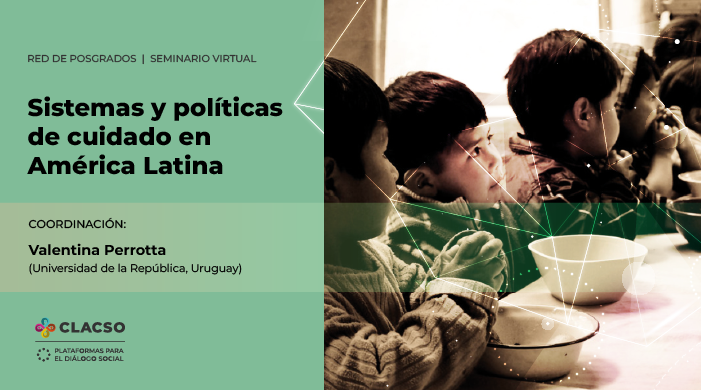
Seminar 2402
ChairCLACSO
CoordinationValentina Perrotta (University of the Republic, Uruguay)
Teaching team: Karina Batthyány (University of the Republic, Uruguay), Valentina Perrotta (University of the Republic, Uruguay), Juliana Martínez (University of Costa Rica), Laura Pautassi (University of Buenos Aires, Argentina), Catalina Arteaga (University of Chile), Paula-Irene Villa Braslavsky (University of Munich, Germany), María Eugenia Palop (Carlos III University of Madrid, Spain), Nadya Araujo-Guimaraes (University of São Paulo, Brazil)
Home: 21/03/2024 | Registration: 27/10/2023 to 20/03/2024
Workload: 12 weeks – 90 hours.
This course aims to focus on care policies developed by Latin American and European countries. It will present paradigmatic or prominent cases from countries in the region related to the development of their public care policies, as well as examples from the European experience. The approach will be developed through a comparative analysis of public policies related to families, social protection, care, life course, and well-being from a gender perspective in different countries of the region. Case studies of care policies in Uruguay, Costa Rica, Argentina, Chile, Spain, and Germany will be presented, based on research by women, allowing for an understanding of each country's trajectory regarding these types of policies.
Care policies have acquired a central character in recent years in the region, promoted by at least the following elements: conceptual and research advances on care in academia, the demands of the feminist movement, and changes in the rights agenda of public policies that incorporate new rights, such as the right to care.
This course takes a comparative approach, showcasing the various advancements in care policies across different countries in the region. This highlights both the changes and the challenges these policies face in effectively integrating a gender perspective. European countries, with their distinct histories in care and their different institutional, political, and economic contexts, also present unique challenges to public policy. While this course will explore policies from local perspectives, it will also incorporate a comparative lens, fostering a shared reflection on common problems and persistent challenges in care policies.
GENERAL PURPOSE
- To contribute with a comparative view and through the analysis of specific cases, on public care policy at the regional and European level, allowing reflection on the lessons learned and good practices in the inclusion of the gender perspective in these policies.
SPECIFIC OBJECTIVES
- To learn about the experience of countries in the region regarding care policies
- To contribute a comparative public policy perspective on this type of policy.
- To contribute to the development of a reflection on good practices regarding the inclusion of the gender perspective in care policy.
- Types of care policies and Familisms.
- A comparative look at the social organization of care in Latin America
- The case of Uruguay I
- The case of Uruguay II
- The case of Chile
- The case of Argentina
- The Costa Rican experience from a comparative perspective
- The German experience in the European context
- The case of Spain in the context of COVID
- Aguirre, Rosario (2014) «Care policy in Uruguay: a step forward for gender equality?». Revista Estudos Feministas, vol. 22, no. 3, Sept-Dec, pp. 795-813
- Aguirre, Rosario and Ferrari, Fernanda (2014) The construction of the care system in Uruguay In search of consensus for a more equitable social protection, Montevideo: ECLAC,
- Batthyány, Karina and Genta, Natalia (2020) Uruguay: advances and challenges in research and public policies on care. In Guimaraes, Nadya and Hirata Helena (compilers) In Care in Latin America, Horizons of Care Collection. Medifé Publishing House. Buenos Aires.
- Batthyány, Karina and Genta, Natalia (2020) Uruguay: advances and challenges in research and public policies on care. In Guimaraes, Nadya and Hirata Helena (compilers) In Care in Latin America, Horizons of Care Collection. Medifé Publishing House.
- Carrasco, Cristina, Care as the backbone of a new economy. Cuadernos de Relaciones Laborales. Vol. 31, No. 1 (2013) 39-56
- Daly, M. (2011) 'What Adult Worker Model? A Critical Look at Recent Social Policy Reform in Europe from a Gender and Family Perspective', Social Politics: International Studies in Gender, State & Society, 18(1):1-23
- Daly, Mary and Lewis, Jane (2011) «The concept of “Social Care” and the analysis of contemporary welfare states», in Carrasco, C.; Borderías, C. and Torns, T. (eds.). Care work: history, theories and politics, Madrid: Catarata.
- In Guimaraes, Nadya and Hirata Helena (compilers) In Care in Latin America, Horizons of Care Collection. Medifé Publishing House. Buenos Aires.
- Guimaraes, Nadya and Hirata Helena (2020) National realities, Latin American challenges
- Marx Ferree, M. (1993) 'The Rise and Fall of "Mommy Politics": Feminism and Unification
- Ostner, I. (2010) '"Farewell to the Family - Family Policy Reform in Germany": From Bismarck to conservative universalism? The politics, problems, and prospects of the German
- Pazos, M. (2018) Against Patriarchy. Feminist Economics for a Just and Sustainable Society, Katakrak Publishing House, Pamplona. Chapter 2
- Rodríguez Enríquez, C. and Pautassi, L. (2014). The social organization of childcare. Elements for the construction of a care agenda in Argentina. Pages 101-150.
- Sanchez-Aconchea, Diego, Martinez, Juliana, (2018) Overcoming Segmentation in Social Policy? Comparing New Early Education and Childcare Efforts in Costa Rica and Uruguay. Bulletin of Latin American Research. Society for Latin American Studies. Oxford.
- Saraceno, Chiara (2016) «Varieties of familialism: Comparing four southern European and East Asian welfare regimes». Journal of European Social Policy, vol. 26 (4), pp. 314-326.
- Thiessen, B. / Villa, P.-I. (2019, forthcoming): Care and its discontents: The German Case. Unpublished manuscript, under review at International Journal of Care and Caring. 25 pages welfare state', German Policy Studies, 6(1):211-244
- Pazos, M. (2013) Unequal by Law: Public Policies Against Gender Equality. Catarata Publishing House, Madrid. Chapter 5 “Childcare and Dependency Systems…for Women?”
- Perrotta, Valentina (2020) Gender and Care Policies in Uruguay: Moving towards a virtuous relationship?
In: Batthyány, Karina (coord..) (2020) Latin American perspectives on care. 1st ed.- Autonomous City of Buenos Aires: CLACSO; Mexico City: Siglo XXI, 2020. - Perrotta, Valentina (2020) Parental leave and gender co-responsibility in Uruguay: policies, practices and gender mandates in tension. Doctoral thesis, Faculty of Social Sciences, University of the Republic. Chapter 2.4, 5 and 6.4.
|
|
Discount for one payment until 14/03 |
In one payment after 14/03 |
|
CM Plenos |
$75 |
$150 |
|
CM Associates |
$95 |
$190 |
|
No link |
$95 |
$190 |
* Residents of Argentina will pay the equivalent in Argentine pesos according to the official exchange rate of the Banco de la Nación Argentina (BNA) on the day of payment
FAQ
The basic requirements for taking a seminar are:
- Availability of at least 4 hours per week to dedicate to the seminar course.
- Internet access.
- Reasonable handling of communication and computer tools.
- Language proficiency in the language in which the course will be taught. The official languages are Spanish and Portuguese.
The seminars last 12 weeks, plus the completion of a final project. A total of 90 hours of dedication will be credited.
A course consists of twelve classes, each accompanied by required reading bibliography, supplementary bibliography, discussion forums and training activities proposed by the teaching team, partial deliveries and a final project.
The course is online and asynchronous. Some instructors may propose synchronous activities. In those cases, the time and date will be agreed upon beforehand between the teaching team and the students to ensure everyone's participation.
To pass the seminar, you must participate in at least 80% of the discussion forums and activities proposed by the teachers, have completed the scheduled partial deliveries, and pass the final work.
|
|
Discount for one payment until 14/03 |
In one payment after 14/03 |
|
CM Plenos |
$75 |
$150 |
|
CM Associates |
$95 |
$190 |
|
No link |
$95 |
$190 |
* Residents of Argentina will pay the equivalent in Argentine pesos according to the official exchange rate of the Banco de la Nación Argentina (BNA) on the day of payment

