
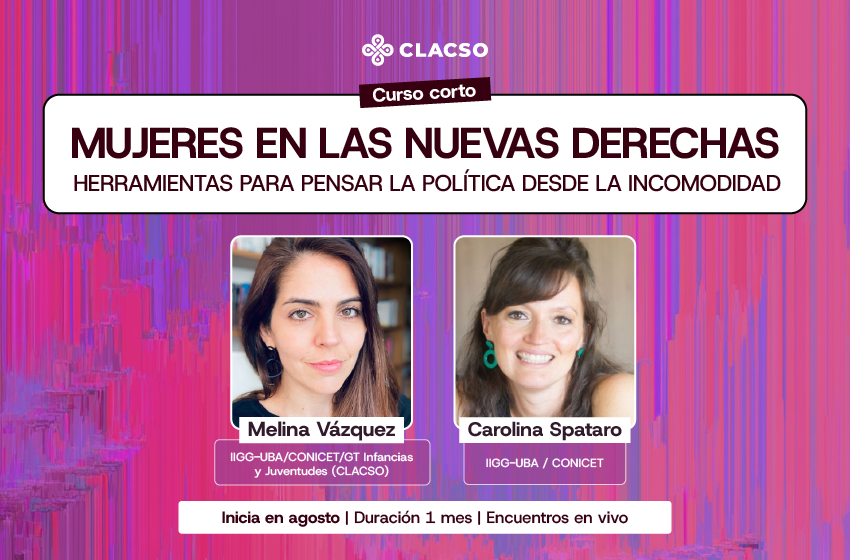
Women in the new right. Tools for thinking about politics from a place of discomfort.
EXECUTIVE
Melina Vázquez and Carolina Spataro (UBA, Argentina)
PROFESSORS
Melina Vázquez (UBA, Argentina) | Carolina Spataro (UBA, Argentina) | Claudia Jareño (UAM, Spain)
Start: 12/08/2026 | Registration: 10/06/2026 to 11/08/2026
Format: Virtual with live classes and exclusive materials
Workload: 50 hours
Duration: 1 month
The expansion of the new right in Latin America has been explained primarily by its agendas of economic liberalization, its critique of the state, its ideological components—such as antifeminism or the rejection of so-called "gender ideology"—or its place within a broader global phenomenon. Few studies have questioned who its adherents are, how and why they hold these ideas, or even why they are active within this movement. The focus has been mainly on young people in precarious employment or men angered by the advances of feminism. However, the new right also includes female figures—such as María Corina Machado (Venezuela), Keiko Fujimori (Peru), Laura Fernández Delgado (Costa Rica), and Victoria Villaruel (Argentina)—as well as activists.
Who are these women? Were there others before them? How did they get there? What are their demands? How does this activism relate to the expansion of feminist agendas over the last decade and the large-scale mobilizations in favor of legal abortion or against femicides?
This course offers tools for analyzing this phenomenon without resorting to simplistic and obvious explanations. To that end, we will delve into the present, but also explore a broader historical perspective that encourages a fresh look at current events. No prior knowledge is required, only a willingness to immerse yourself in an unexplored world and an openness to asking uncomfortable questions.
LIVE MEETINGS
Meeting 1. Do they campaign against their interests?
In recent years, the number of women who vote, are active in, and identify with the new right has grown. How can we explain this feminization of the contemporary right? Are they acting against their own interests? Do they lack information? How can we address these questions without underestimating these women's perspectives? The first class seeks to explore who they are, why they are there, and under what conditions—historical, political, and personal—their activism becomes possible.
Meeting 2. Are they all conservatives?
When discussing women on the right, the image that usually emerges is the same: conservative, religious, defenders of the traditional family. This gathering aims to complicate that portrayal. Through the trajectories of public figures who hold or have vied for positions of power on the right in the region, we observe that the differences between them are significant: generational, class-based, professional, and political. There are married and divorced women, women with and without children, lifelong activists and newcomers to politics. Their agendas also vary: economic freedom, security, national identity, individual rights. Looking at them more closely reveals a more heterogeneous—and more surprising—landscape than we usually imagine.
Meeting 3. Can one be a feminist and right-wing?
There are women who are active in the new right and also identify as feminists. Who are they? What do they understand by feminism? How do they articulate this identity with the issues discussed in their respective countries? What categories do they use to define themselves? Academia, for its part, has developed a series of concepts to study this phenomenon: "antifeminism," "neoliberal feminism," "postfeminism," "femo-nationalism," and "identity feminism." What does each one illuminate? What does it leave out? Using these tools, we discuss the potential and limitations for analyzing women's political participation in the new right.
Meeting 4. What remained of feminism after the tide?
To conclude the course, we analyzed the massification of feminism and its derivations: what transformations it produced, what tensions it generated, and how it coexists with the advance of the new right in the region.
PILLS. Recorded material
Pill 1. What made women's suffrage possible in Latin America? Three cases, multiple disputes
Women's suffrage in Latin America has a complex history, shaped by a question that framed much of the debate at the time: if women's suffrage is approved, which party will it benefit? In Argentina, decades of struggle by socialist, radical, and feminist activists preceded the law passed under the Peronist government in 1947. In Chile, it was the Conservative Party—supported by networks of Catholic women—that introduced the first bill in 1917, and suffrage was finally granted in 1949. In Paraguay, the last country in the region to recognize it, decades of feminist organizing and international pressure created the conditions for the Stroessner dictatorship to pass the law in 1961. This article explores these three cases to consider the relationship between women and politics from deeper and more unexpected perspectives.
Pill 2. France: feminist, nationalist and anti-immigrant militancy in the present
France is home to one of the most relevant cases for studying the intersection of feminism and the new right: the collective Némésis, founded in 2019, which articulates the defense of women's rights with an anti-immigration discourse grounded in the "defense of European identity." For Némésis, the threat to women comes not from patriarchy but from multiculturalism. This article analyzes how this intersection between feminism and national identity operates in France and proposes a discussion about the international component that is often used to describe the new right.
- Melina Vázquez (UBA, Argentina)
- Carolina Spataro (UBA, Argentina)
- Claudia Jareño (UAM, Spain)
The course is delivered online. It consists of four synchronous (live) sessions plus two pre-recorded modules available for free viewing. The live sessions will be held via Zoom on Thursdays, August 13, 20, and 27, and Monday, August 31, from 18:30 p.m. to 20:30 p.m. (Argentina time). Participants will have access to exclusive materials in the virtual classroom. The final assessment is an individual questionnaire.
| Early registration (until 08/07) | General registration (09/07) as of 10/08) | Registration without discount (11/08 to 12/08) | |
| Full or Associate Member Center | $100 | USD 150 | $200 |
| No link | $150 | USD 225 | $300 |
Inquiries: [mail protected]

