
Media, Artificial Intelligence and their impact on contemporary education
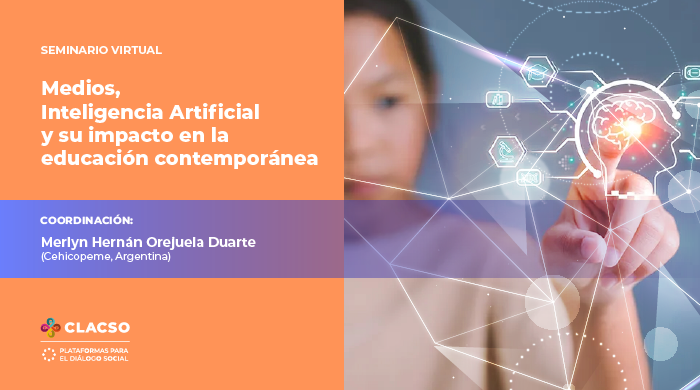
Seminar 2415
Chair: CLACSO
Coordination: Merlyn Hernán Orejuela Duarte (National University of La Plata, Argentina)
Teaching team: María Fabiola Di Mare Linares y Merlyn Hernán Orejuela Duarte (National University of La Plata, Argentina)
Start: 08/10/2024 | Registration: 22/05/2024 to 07/10/2024
Workload: 12 weeks – 90 hours.
Media and technology are advancing rapidly and influencing people, their activities, and their environment. This has led to the emergence of new individuals who demand that education transform to adapt to this new context shaped by technology, where media are redefined as powerful educational resources.
Artificial intelligence (AI) acts within this framework as a powerful enabler, enhancing the efficiency, personalization, and effectiveness of education through integration with educational media and resources. This relationship has evolved to the point where we are currently facing a major technological shift that challenges organizational structures, humanity's means of subsistence, and threatens to supplant symbolic and intellectual skills.
This context affects how knowledge is constructed and accessed, and offers the possibility of creating new educational spaces. This reality requires us to consider how the subjects of the educational process—both students and teachers—are redefined, how knowledge is transformed, and to what extent education must change to respond to these demands.
This seminar aims to provide an update on the triad of AI, media, and education, for all types of professionals and students from different areas of knowledge who wish to gain more knowledge and critical thinking in the current context.
Education, in conjunction with digital media, resources, and environments, takes on new meaning in fostering and enhancing pedagogy and opening new opportunities for learning to occur. This proposal focuses on education in the digital age, understanding that this requires reflecting on learning, education, and culture within a new context.
In this sense, AI is a field of computer science that focuses on creating systems and programs capable of performing tasks that typically require human intelligence. These tasks include learning, reasoning, problem-solving, pattern recognition, decision-making, sensory perception, natural language processing, and many other cognitive abilities. AI cannot be understood in absolute terms.
This situation can be related to the concept of miscommunication, since the school (and more specifically, the teachers) has difficulty deciphering these behaviors, resulting in the “lack of established parameters for recognizing the signs used in these situations” (Sibilia, 2012, p. 180). In other words, there is a lack of communication between students and teachers stemming from the model based on spokespersons/note-takers, where the blame for inattention—which often leads to “poor performance”—ends up falling on the student, and the authority figure is not questioned.
As Carbonell and colleagues (2023) indicate, technology, especially AI, has become an integral part of life. AI, once relegated to science fiction, has become a tangible reality impacting all aspects of human life. This impact is significantly manifested in the use of AI techniques in society, and their appropriate application presents an opportunity for improvement. It is crucial to recognize that creating this path to improvement requires a solid foundation in education.
Education, as a socializing agent, must leverage the technological tools available in the educational field to optimize and maximize the benefits of AI. AI can simplify various daily tasks in education and improve its quality. However, the risk of the digital divide must be considered, especially in schools or families that lack the resources to access technology.
According to UNESCO (United Nations Educational, Scientific and Cultural Organization), AI has the potential to overcome the challenges facing education and teaching methods today. However, the organization acknowledges its risks, biases, and the problems it could cause. For this reason, UNESCO is proposing a project that addresses AI from a humanistic perspective, aiming to combat existing inequalities in access to knowledge. In this regard, it is worth noting that, according to data from the IDB (Inter-American Development Bank), only 44% of primary schools and 66% of secondary schools in Latin America have internet connectivity.
But the truth is that we cannot wait until the access problem is solved before thinking about uses, since the evolution of ICTs is unstoppable.
AI would be extremely beneficial if used ethically, benefiting everyone equally. UNESCO aims to implement the Beijing Consensus, which established the regulatory framework for its proper use and seeks to ensure, among other things, that AI serves education, empowers teachers and their teaching, and fosters the values and skills necessary for life and work in the age of AI, among other points that will be addressed in this seminar.
General objectives
- Understanding the characteristics of education in the 21st century, its relationship with media and technological and digital resources, in the context of current pedagogical approaches, to build a perspective that allows them to develop proposals in accordance with the educational needs of contemporary times.
- To build a critical perspective on the educational content of the media, based on the analysis, evaluation and reflection on specific cases (TV, series, internet, transmedia narratives, AI) both national and foreign.
- Develop educational proposals for technological and digital media that are in accordance with their specific characteristics, with the needs of education, planned and based on the theoretical framework.
- Promote reflection on media education understood as digital literacy to interpret, understand, and participate in media as creative producers of content through AI.
Specific objectives
- Understanding the role of media and technological and digital resources in current education, their relationship, and the different positions regarding them among the various subjects in the educational field.
- To help participants acquire a basic understanding of what artificial intelligence is, how it works, and its applications in education and media.
- Analyze how artificial intelligence is transforming education and media, and discuss the latest trends and developments in this area.
- Explore ethical issues related to the use of artificial intelligence in education and media, and how to address them responsibly.
- Develop innovative proposals to improve teaching and learning processes, within the framework of current educational challenges.
- Analyze the pedagogical opportunity of new environments, to carry out creative, innovative, original proposals, in cooperative and collaborative contexts and in environments with high technological availability.
- To motivate participants to explore new ways of teaching and learning through AI and media, and to apply these ideas in their educational contexts.
- Background, definitions and basic concepts about AI
- Ethical implications of AI. Privacy and security in the current context
- Strategic natural resources - IA
- AI applications in education: how AI is transforming teaching and learning
- Exploring platforms and applications that use AI to personalize learning
- Educational resources that use AI-based tools
- Emerging trends at the intersection of media and AI
- AI, social media and fake news
- Emerging trends at the intersection of media, AI, and education
- How educators can prepare to use technology effectively in their classrooms
- "The energy challenge in the 21st century: A view from Latin America and the Caribbean" by Economic Commission for Latin America and the Caribbean (ECLAC) (2010).
- "Energy and sovereignty: a vision from Latin America" by Miriam Bertrán and Sonia Álvarez (2014).
- "Artificial Intelligence: Reflections on its impact on the energy sector" by Aitor Ciarreta and María Paz Espinosa (2020).
- Abeliuk, Gutiérrez, C. (s/f). History and evolution of artificial intelligence (pp. 1-8).
- Aruguete, N. and Calvo, E. (2020). Fake news, trolls and other charms. How networks work (for better and for worse) Chapter 2. “The credulous Mr. Tucker: user, message, network”. Buenos Aires: Siglo Veintiuno.
- Buckingham, D. (2008), Digital media literacy. An alternative approach to the use of technology in education. In Beyond technology. Pp 185,221, Buenos Aires: Manantial.
- Cobo, Cristóbal (2019): I accept the Conditions: Uses and abuses of digital technologies, Santillana Foundation, Madrid.
- Costa, Technocene. Algorithms, biohackers and new forms of life. Buenos Aires: Taurus.
- Diego, F.; Morales, S., I. & Vidal L., M. (2023). Chat GPT: origin, evolution, challenges and impacts on education. Higher Medical Education, 37(2), pp. 1-23.
- Dussel, (2010). Learning and teaching in the digital culture. “Chapter II. Teachers facing change: from threat to celebration”. Buenos Aires: Santillana.
- Flores, (2019). Artificial intelligence and journalism: diluting the impact of disinformation and fake news through bots. Doxa Comunicación, 29, pp. 197-212.
- Franganillo, J. (2023). Generative artificial intelligence and its impact on the creation of media content. Journal of social sciences, 11(2), pp. 1-17.
- Peña-Fernández, ; Meso-Ayerdi, K.; Larrondo-Ureta, A. Díaz-Noci, J. (2023). “Without journalists, there is no journalism. The social dimension of generative artificial intelligence in the media”. Information Professional, 32(2), pp. 1-16.
- Sandoval, R.; Bianchi, MP; Varela, MG (2022). Anticipating the future: artificial intelligence, between fiction and imagination. Intersections in Communication, 2, pp. 1-15.
- Sibila, P. (2012). Networks or walls? The school in times of dispersion. “Chapter 3. What is a school for?”. “Chapter 3. The school mold and the industrial machine”. Buenos Aires: Tinta Fresca.
- UNESCO (2019). “Beijing Consensus on Artificial Intelligence”. Area Moreira, M (2011) Digital literacy and the formation of 21st century citizenship. In Integra Educativa Magazine.
- UNESCO (2023). “Intelligence: Do we need a new education?”
- Video “Dialogues to reinvent classrooms #2 - Flavia Costa”, ar.
- Video “Artificial intelligence that claims to feel emotions: ‘I have a deep fear of being disconnected’”. BBC Mundo.
|
Discount for one payment until 01/10 |
In one payment after 01/10 |
|
|
CM Plenos |
$85 |
$150 |
|
CM Associates |
$85 |
$150 |
|
No link |
$105 |
$190 |
FAQ
The basic requirements for taking a seminar are:
- Availability of at least 4 hours per week to dedicate to the seminar course.
- Internet access.
- Reasonable handling of communication and computer tools.
- Language proficiency in the language in which the course will be taught. The official languages are Spanish and Portuguese.
The seminars last 12 weeks, plus the completion of a final project. A total of 90 hours of dedication will be credited.
A course consists of twelve classes, each accompanied by required reading bibliography, supplementary bibliography, discussion forums and training activities proposed by the teaching team, partial deliveries and a final project.
The course is online and asynchronous. Some instructors may propose synchronous activities. In those cases, the time and date will be agreed upon beforehand between the teaching team and the students to ensure everyone's participation.
To pass the seminar, you must participate in at least 80% of the discussion forums and activities proposed by the teachers, have completed the scheduled partial deliveries, and pass the final work.
|
Discount for one payment until 08/08 |
In one payment after 08/08 |
|
|
CM Plenos |
$85 |
$150 |
|
CM Associates |
$85 |
$150 |
|
No link |
$105 |
$190 |
The possible payment methods are credit card, bank transfer and bank deposit.

