
Struggles and memory in Latin American art
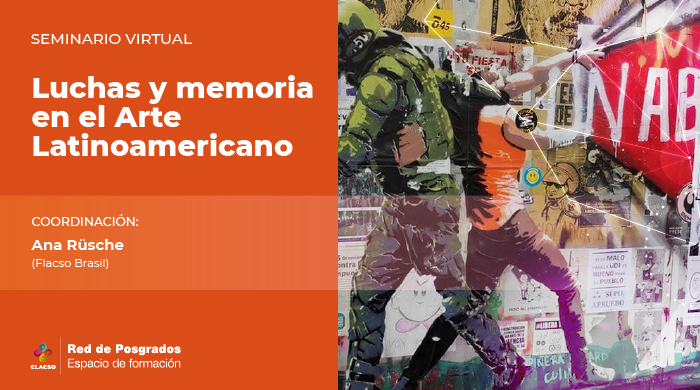
Seminar 2308
Chair: CLACSO
Coordination: Ana Rüsche (Flacso Brazil)
Start: 23/03/2023 | Registration: 15/12/2022 to 22/03/2023
Workload: 12 weeks – 90 hours.
Artistic manifestations in Latin America are only remade by dialogue with resistance movements and amplify the demands of social movements. In contrast to other international artistic traditions, Latin American production is characterized by its pendor on popular struggles and a repudiation of authoritative forces, even as the artistic medium has more different individual ideological positions.
The seminar aims to address artistic production in different countries and traditions in the period of 1970 years ago. The works selected, with emphasis on literature, for analysis mark the respective eras, not only awarded with prizes, but being marked, above all, by a perspective of popular art. Art, expressed many times through cultural products, is situated in a field of constant hegemonic tensions — on the one hand, dependent on capitalist distribution models for the remuneration and survival of artists, with complex technical production chains — for example in audiovisual, phonographic and publishing productions; On the other hand, questioning and discussing, just as it is imagined, is the same distribution. More complex these tensions are presented in moments of censorship or of acirramentos caused by the rise of extreme directness in points of the continent. Thus, when discussing art and resistance, these tensions are shown to be a relevant area of analysis.
The selected works pass through different regions and eras, with an emphasis on contemporary resistance. The program begins with the experience of exile and resistance against dictatorship, as the iconic album by Brazilian Caetano Veloso from 1969 and with the interventions of the Chilean collective CADA — Collective of Art Actions, originally formed by Fernando Balcells, Juan Castillo, Diamela Eltit, Lotty Rosenfeld and Raúl Zurita in 1979.
After discussing works that present this memory linked to groups that suffer constant blackouts, for example LGBTQIA+ groups and black people, discussions are drawn in the texts I speak for my difference , manifesto by Chilean Pedro Lemebel (1986), poems by Uruguayan Alfredo Fressia and Argentinian Néstor Perlongher, published in the years 1990 and excerpts from the historical narrative Eu, Tituba: black bruxa de Salem , by Guadalupe writer Maryse Condé (1986, with original title Moi, Tituba, sorcière… noire de Salem ).
In the XXI century, the program runs through the theme of memory and resistance, based on the idea of belonging and survival in the face of an economic scenario of recess and unemployment, overwhelming women. For this discussion foram colhidas o conto Olhos D'água , by Brazilian Conceição Evaristo (2015), and the film Rio das Lágrimas secas , by Brazilian director Saskia Sá (2018). Advancing the gender quests, foram chosen by the works Soñarán en el Jardín , by the Mexican Gabriela Damián Miravete (2015), which discusses the feminicide quest in the work of the Mexican plastic artist Elina Chauvet, Red Shoes , a public art project that began in 2009.
The program encloses with an ecological discussion guided by various artistic voices of the continent. Within photography, approaches to portraying the Anthropocene will be discussed. We essays and debates, we study an interview Conversatório sobre o Bem Viver , by Bolivian educator Mario Rodríguez Ibáñez (2016), Ideias para adiar o fim do mundo , by Ailton Krenak (2020) and a narrative Semilla , by Mexican Illiana Vargas (2019).
There will be seven theoretical classrooms, with exhibition and debate on works of art, and three practical classrooms, where there will be exercises of creation and elaboration of essay scraps on the topics discussed. To attend the seminar, in addition to the readings and discussions, it will be the purpose or exercise to prepare a "Field Diary", a notebook of notes and reflections, so that you can observe your surroundings and your creative discoveries. The final delivery of the work may be made in the molds of a scientific article or an essay, but also in the molds of a fictional narrative in prose on some of the topics addressed in the course, accompanied by a dissertation text with respective theoretical justification.
Popularizing art and transforming it into a form of resistance also involves expanding the positions in which art is analyzed. As a critic we are faced with the tasks of making artistic production and experiencing everyday life, looking at our own memories and experiences. This form, the seminar proposes to students to take the position of analysts to also integrate the artistic point of view, making notes in their "field diaries", creative and analytical elaboration tools. The selected works do not program part of hot discussions now and open up the possibility for them to risk telling their own narratives, whether in the form of essays or in the form of artistic productions.
GENERAL PURPOSE
The seminar aims to invite people to reflect on respect for the artistic productions of the last 50 years, based on both an analysis of aesthetics and content, offering the possibility of questioning manifestations and executing creations based on the analysis of notable works from different authors and countries.
SPECIFIC OBJECTIVES
Objective-se que estudiantes:
- Possessing works from different artistic traditions in different periods on the continent, I have contact with diverse historical demands.
- Get in touch with your own memory and your daily life in a creative way, by using the "field diary" tool.
- You have the opportunity to exchange opinions and reflections during the synchronous classrooms and exercises in the forums.
- If so, it will be allowed to experiment or do artistic work.
- Art, market and resistance
- Dictatorship and exile
- Unicórnios, éguas ea irrupção dissident
- Tituba, a historical romance
- The art of survival
- Feminicide, complaint and reparation
- Test practice: memory and everyday life
- Portraits of the Anthropocene
- Writing practice: resistance, ecology and imagination
- Writing practice: memory and everyday life
- ADORNO, Theodor W. Seleção by Jorge Mattos Brito de Almeida. Cultural industry and society. São Paulo: Paz e Terra, 2002.
- CARRERES, Analía Ferreyra. Liquid Cartographies. Violence against women in five contemporary Latin American short stories. Thesis to obtain the title of Master in Literature, Culture and Media, Lunds Universitet, 2020.
- CONDÉ, Maryse. Tituba: Black Witch of Salem (trans. Natalia Polesso). Rio de Janeiro: Rosa dos Tempos, 2019. (blacked out portions)
- EVARISTO, Conceição. "The graphic-design of my mother, two places of birth of my writing." Brazilian performative representations: theories, practices and their interfaces. Belo Horizonte: Mazza Edições, 2007.
- EVARISTO, Conceição. "Olhos D'Água". In Olhos D'Água. São Paulo: Pallas, 2013.
- FRÁGUAS, Márcia (2019). The empty boat: A prison and exile experience in Caetano Veloso (1969). Opinions, (15), 34-53.
- FRESSIA, Alfredo. Evicted song (trans. Fabio Aristimunho Vargas). Campinas: Lumme, 2010.
- IBÁÑEZ, Mario Rodríguez. Conversatório sobre o Bem Viver, Challenges of doing politics in our time. Debate point, Fundação Rosa Luxemburgo, number 4, January 2016.
- Ailton. Ideas to add to the end of the world. Companhia das Letras, 2019.
- KRIEGER, Peter. "Architectural and landscape photography of the late Anthropocene: the Humboldtian spirit in the work of Fernando Cordero." Bitácora Arquitectura 41, 2019.
- LARROSA, Jorge. The Essay and Academic Writing. Revista Propuesta Educativa, Year 12, No. 26, Buenos Aires, FLACSO, July 2003. Available at https://hum.unne.edu.ar/asuntos/concurso/archivos_pdf/larrosa.pdf (in português: O essaio ea written acadêmica. Educação e realitye, v. 28, n. 2, jul/dez, 2003).
- LE GUIN, Ursula. A fiction like a basket. Translated Priscilla Mello. Review: Ellen Araujo and Marcio Goldman.
- LEMEBEL, Pedro. "I speak for my difference." In SUTHERLAND, Juan Pablo (ed.). With an open heart: literary geography of homosexuality in Chile. Santiago de Chile: Sudamericana, 2002
- MAUAD, Ana Maria, LOPES, Marcos de Brum. “O olho do Antropocene — Fotografia diante do tempo.” In TORRES, Sonia, PENTEADO, Marina. Literature and art in the Anthropocene — Conceitos e representations. Rio de Janeiro: Edições Makunaima, 2021.
- MEIRELES, Cildo. Insertions in ideological circuits (depoimento). Poro Magazine, 11/23/2011.
- MENTEGUIAGA, Clarisa. Anthropocene: Irreversible Repetitions. Dissertação de mestrado. Pontifical Catholic University of Chile (Chile), 2018.
- MIRAVETE, Gabriela Damián. "They will dream in the Garden." In Latin American Literature Today, v. 1, no. May 6, 2018 (in Portuguese: MIRAVETE, Gabriela Damián. "Sonharão no Jardim", trans. Ana Rüsche, Mafagafo - Aves Migratórias, April, 2021)
- NELLY, Richard. Margins and Institution. In Art in Chile since 1973: avant-garde scene and society. Santiago: FLACSO, 1987, p. 1-13.
- OESTERHELD, Héctor Germán and LÓPEZ, Francisco Solano. El Eternauta — special edition supplementary literature. Buenos Aires: Doedytores, 2012.
- PAULA, Irene de. "Maryse Condé and Tituba Indien: feiticeiras do imaginário." Itinários, Literature Magazine (2016).
- PERLONGHER, Nestor. "Like a queen that ends" ("Like rainha that ends", trans. Josely Vianna Baptista). In Néstor Perlongher. Poetry of Ibero America, site Antonio Miranda
- YES, Saskia. Dry Tears River. 25 minutes, 2018.
- VARGAS, Illiana, Women Who Imagine. Jerónimo Magazine. Mexico City, 01/24/2019
- VARGAS, Illiana. Seed. In Exchanges, Journal of Literary Translations, The University of Iowa, College of Liberal Arts & Sciences, Issue Interations, Fall 2019.
- VELOSO, Caetano. Caetano Veloso. Phonogram/Polygram, 1969.
- WEINHARDT, Marilene. Considerations on historical romance. Letters Magazine. 1995.
- WIECZOREK, Gabriela Traple. "We want each other alive: contemporary art about feminicide in Brazil and in Mexico." Dissertação in visual arts. Federal University of Rio Grande do Sul, 2021.
|
|
Discount for one payment until 13/03 |
In one payment after 13/03 |
|
CM Plenos |
$75 |
$150 |
|
CM Associates |
$95 |
$190 |
|
No link |
$95 |
$190 |
FAQ
The basic requirements for taking a seminar are:
- Availability of at least 4 hours per week to dedicate to the seminar course.
- Internet access.
- Reasonable handling of communication and computer tools.
- Language proficiency in the language in which the course will be taught. The official languages are Spanish and Portuguese.
|
|
Discount for one payment until 13/03 |
In one payment after 13/03 |
|
CM Plenos |
$75 |
$150 |
|
CM Associates |
$95 |
$190 |
|
No link |
$95 |
$190 |

