What we can learn from tracking research funding flows from north to south

This blog was originally published in English on the LSE Impact blog and in Spanish on Global dev.
Francesco Obino
Measuring the reach of research funding from the Global North to the Global South is complex and often overlooked beyond the headline figures. Considering a new project to track global research funding flows for development, this blog suggests how new evidence could provide valuable insights into key questions facing the international development sector.
A decade and a half after exploring research funding (its modalities, its effects on organized intellectual research and its aspirational link with socioeconomic development) I keep returning to the same persistent question:
Is the central question whether research funding supports scientific research (and therefore whether its structure is adequate) or how much funding is available (echoing classic " big push " debates in development funding)?
All researchers complain about funding cuts, but when it comes to systems that are structurally and chronically underfunded, prioritizing and clarifying these questions becomes essential.
Where does research funding go and who uses it?
In a recent article, I asked a related and surprisingly difficult question: what are existing funds actually being used for? Why do research donors seem to lack a clear mandate to fund the kind of research they claim to want—transformative, impactful, and transdisciplinary work—and all that supports it? I'm not the only one asking this.
At the Global Development Network, where I coordinate the Doing Research initiative , we have been asking for over a decade who is funding research at the national level: which researchers and what research? We consistently find that national science ministries in low- and middle-income countries (LMICs) often lack even basic information, let alone usable data, about who is funding their own social sciences. In many cases, they don't even know how many social scientists are conducting research in (or about) their country.
Monitoring research funding flows
Regarding the amount of research funding deployed, last year a team from the OECD's Development Cooperation Directorate, which also serves as the Secretariat of the Development Assistance Committee (DAC), attempted to track the amount of Official Development Assistance (ODA) allocated to development research. After all, several of the OECD DAC's sectoral codes (the standard for donors to report their expenditures) relate to research ( although it is unclear where social science research would fit in ).
They were disheartened by the figure they uncovered: in 2022, only 1% of bilateral aid from DAC countries went to research and development, and only 0,2% to research institutions, highlighting significant gaps in the data. This comes after ODA for research and development fell from US$2.7 billion in 2018 to US$1.7 billion in 2022 (more than a third, in real terms). Seven DAC members provide the lion's share of the funding, and in this era of cutbacks, the sector's reliance on a few donors raises concerns about both a lack of diversification and how other funders support or report on evidence. The problem is that research is embedded throughout development, so pervasive and essential that, ironically, reporting standards are not particularly useful for tracking it.
Oxfam International developed a methodology to track invisible and undeclared funding flows in humanitarian emergencies, and for several years I have been considering how to adapt this approach to make sense of North-South research funding flows.
UKCDR and the Pandemic Science Institute have already shown that mapping global research funding, at least in relation to pandemics, is both feasible and worthwhile . A team from NUPI in Oslo and ACDI in Cape Town did something similar, focusing on climate change research funding and concluding that only 3,8% of global climate change research funding is spent on African issues . But arguably, both teams had a more limited task: mapping research funding within the research funding sector (essentially, analyzing research grant databases). Mapping research funding within the development sector is a more complex and less coherent task. It is also more political.
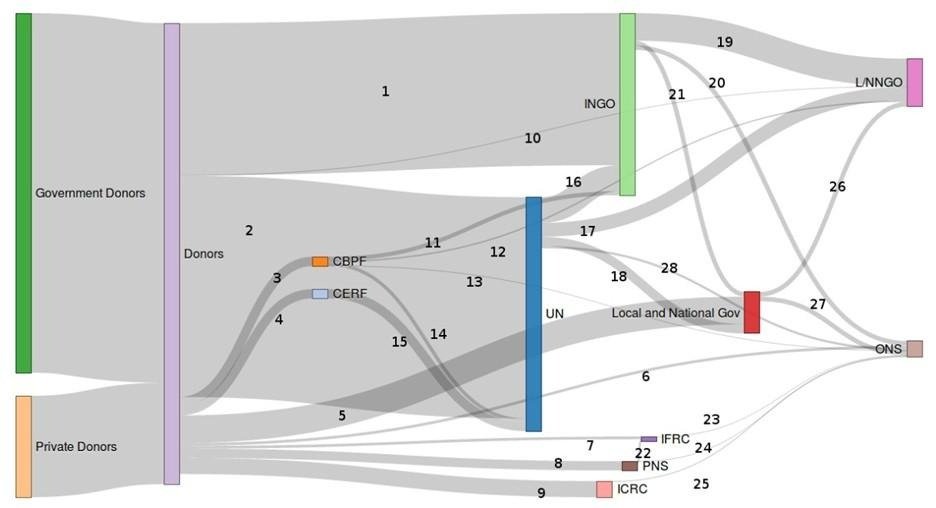
Fig. 1, reproduced from Christian Els' 2017 work on mapping funding flows in the humanitarian sector. What would a graph like this look like if it focused on funding flows for research in the Global South?
Monitoring financing towards the Global South
A team from CLACSO and CWTS (Leiden University), funded by Canada's IDRC, is currently working to answer that question. Their project aims to track global research funding flows with a focus on the Global South, shedding much-needed light on entrenched inequalities and proposing fairer and more inclusive funding systems.
So, perhaps it's time to list the questions that could really change the balance.
Beyond the OECD team's initial question of how much funding from the Global North goes to research, I would ask:
- How much research funding flows to the Global South?
- Does ODA research funding go to institutions in the Global North or the Global South?
- Of the funding that reaches researchers in the Global South (even through North-South collaborations), what questions is it supposed to answer: those of donors, those of researchers, or those of social actors? (Additional question: what incentives do researchers face to co-construct questions with their stakeholders, rather than aligning themselves with questions formulated by their main peers?)
- What part of this funding falls under the development of research capabilitiesThis relationship between research and research capacity building could serve as an indicator of the level of trust donors place in researchers from the Global South to lead (many senior researchers from the Global South are frustrated at being included only because of capacity-building funding). (My favorite additional question: What do we mean by “capacity building”? Where does the funding lead researchers—physically, professionally, and intellectually? How much of the funding goes toward infrastructure, doctoral fellowships, or simply the time of researchers from the Global South in North-South “partnerships”?)
- How much of this funding supports long-term research agendas versus short-term projects? There's a difference between a meal and a garden. Both are useful, even vital, but they serve very different purposes.
Can we change what we cannot measure?
Here's the astonishing part: this information exists . Every funding window has someone behind it who could (in theory) answer these questions. However, this information isn't systematically collected, let alone aggregated, which means we can't analyze it or make informed decisions about where to invest, how to improve fund delivery, or even how much additional funding is needed and who should help raise it.
It is possible that we are in a situation where, as I have argued elsewhere , international research funding is, at best, a neutral factor in national research ecosystems and, at worst, a distortion, distracting researchers from their own questions and keeping the development of research systems and networks in limbo.
And the problem doesn't stop at global or ODA-linked funding. To fully understand under what conditions research can significantly contribute to improving lives and capabilities, we must also examine the role of national public, private, and philanthropic funding . This isn't an obscure or self-referential debate. It's a simple matter of missing data—data that allows everyone to continue doing what they've been doing for a long time, perhaps with reflexivity and compelling visions, but without any real way of knowing whether transformative change is possible.
So why is this important? As Joseph Stiglitz pointed out in a 1999 article, development is about ideas before they become resources . And for ideas to flourish, for those ideas to be tested, refined, and proven, we need research capacity—everywhere. That's not a luxury. If we want to know where the next transformative evidence will come from, we need to see how and if it will be funded.
"This article is part of a series organized with the UK Collaborative on Development Research (UKCDR) on the impact of funding approaches on research. Exceptionally, we accept contributions from researchers, but also from research funders for this series."