
Recent history, public uses of the past, and collective action
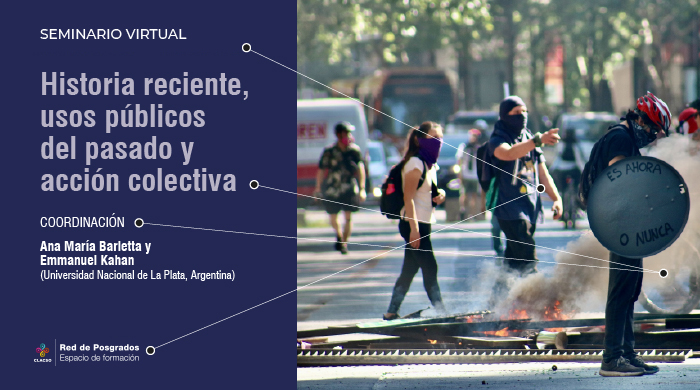
Seminar 2307
Chair: CLACSO
Coordination: Ana María Barletta and Emmanuel Kahan (National University of La Plata, Argentina)
Home: 23 / 03 / 2023 | Registration: 15/12/2022 al 22/03/2023
Workload: 12 weeks – 90 hours.
This course aims to address and problematize a series of experiences related to how social groups remember the past in relation to present-day struggles and problems. In doing so, it seeks to reflect on how these groups remember and how these memories, linked to narratives of the contemporary public agenda, shape the horizons of expectation in the contemporary world. In this sense, these perspectives, which draw on a complex network of conceptual issues and empirical references, will attempt to reconstruct a temporal order linked to three stages of the Latin American political process: the time of rebellion, the time of repression, and the time of the restoration of democratic stability.
We understand that remembering past events is integral to building our present and future, and as such, it is essential as a political bridge for building a more egalitarian and democratic society. Therefore, we will explore the alternatives, complexities, and pluralities of different perspectives and experiences surrounding the debates over the public use of the past and its integration into collective action. One of these dimensions will, naturally, be the gender perspective and that of inclusive citizenship, which have proven highly productive and innovative in the streets of our region in recent times. This course aims to contribute to building new common understandings within the subjectivities of the present, by recovering the radical nature of truncated pasts and possible futures, in an era so threatened by the new right and the rise of regressive, discriminatory, and intolerant discourses against social movements and human rights, and consequently, against the existence of a substantive democracy for our people.
GENERAL PURPOSE
That students can:
● To understand contemporary debates on the construction of recent history, its challenges and its involvement in the conflicts of the present world, in order to promote political bridges between catastrophic pasts, their impact and the social demand that persists in the present for their understanding.
SPECIFIC OBJECTIVES
That students can:
● To critically reflect on the conceptual, cultural, and political links between the process of “memory explosion” in the contemporary world and, thus, be able to link this problem—beyond their own personal sphere—to the understanding and treatment of their own questions and concerns linked to their national and regional histories.
● Access to an overview of different dimensions involved in the construction of recent history and its public uses: The State, social organizations, trials, spaces of memory, archives, scientific knowledge.
● To reflect on the different dimensions of the social demand for recognition and reparations raised by victims, families, and survivors of catastrophic events. To advance in understanding the political implications of this demand for building a substantive democracy.
● Acquire historical and conceptual tools to engage in processes of transmitting memories in different institutional and educational settings.
- RECENT HISTORY AND MEMORY. The cycle of rebellion, repression, democracy.
- STATE, HUMAN RIGHTS ORGANIZATIONS AND COLLECTIVE ACTION. The consensus on human rights in contemporary democracies
- Truth Commissions and Reparative Policies. Investigating the truth and making amends
- TRANSITIONAL JUSTICE - REPARATIONS. Recognition of victim status, humanitarian discourse, and different access to justice
- LEGAL PROCESSES AND HISTORICAL TRUTH. Legal processes and responsibilities surrounding human rights violations.
- FORENSIC ANTHROPOLOGY. Its role in the identification of victims of genocide.
- SITES OF MEMORY. Spaces, territories and places of memory. Teaching of “extreme histories”
- EDUCATION AND MEMORY. Historical and generational transmission.
- PUBLIC USES OF THE PAST AND COMMEMORATIONS. Tensions and debates.
- THE PAST AS REPRESENTATION. INTERVENTION AND AESTHETIC ACTIVISM. Supports, narratives, and public policy in the cultural field
- Adamoli, C., Farías, M. and Flachsland, C., "Education and Memory. The history of a public policy", Yearbook of History of Education", Vol. 16, No. 2, Autonomous City of Buenos Aires, 2015.
- Da Silva Catela, Ludmila, “The world of archives”, in Da Silva Catela, Ludmila and Jelin, Elizabeth, The archives of repression. Documents, memory and truth., Buenos Aires, Siglo XXI editores, 2002.
- Hernández, Mario Alfredo, “Transitional justice and the rights of victims” in AAVV, The Human Right to Non-Discrimination, Queretaro (Mexico), National Institute to Prevent and Eliminate Discrimination, 2014.
- Rousso, Henry “Developments in the historiography of memory” in Aletheia Magazine, 2018, Vol 8, No. 16. Pittaluga, Roberto, “Recent History in Argentina: problems of definition and topics of debate” in AYER Magazine 107 / 2017 (3).
- Schmucler, Héctor (2006). “The unsettling relationship between places and memories” in Héctor Schmucler (2019) Memory, between politics and ethics. Collected texts (1979-2015) CLACSO.
- Sikkink, Kathryn, “Introduction” and “The Effects of Crimes Against Humanity Trials in Latin America”, in Sikkink, K., The Cascade of Justice: How Crimes Against Humanity Trials Are Changing the World, Buenos Aires, Gedisa, 2013.
- Traverso, Enzo, “The return of the past like lightning”, An interview with Enzo Traverso in Jacobin Magazine 1.02.2022.
- Troper, Michel, “Law and denialism. The Gayssoy Law and the Constitution”, in Anales HSS, November-December 1999, No. 6.
- Vinyes, Ricard, “The memory of the State”, in Vinyes, R. (ed.) The state and memory. Barcelona, RBA Libros, 2009.
|
|
Discount for one payment until 13/03 |
In one payment after 13/03 |
|
CM Plenos |
$75 |
$150 |
|
CM Associates |
$95 |
$190 |
|
No link |
$95 |
$190 |
FAQ

