
Gender(s), city(ies) and territory(ies): Challenges in building a public agenda in Latin America
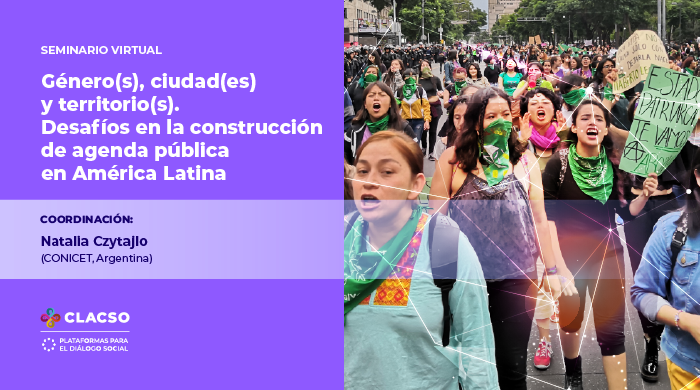
Seminar 2412
Chair: CLACSO
Coordination: Natalia Czytajlo (CLACSO Working Group on Gender, Inequalities and Rights in Tension / CONICET / National University of Tucumán, Argentina)
Teaching team: Natalia Czytajlo (GT CLACSO Genders, inequalities and rights in tension / CONICET / National University of Tucumán, Argentina) | Ana Falu (United Nations / Exchange and Services Centre for the Southern Cone Argentina, Argentina) | Lilian Soto Badaui (GT CLACSO Gender, inequalities and rights in tension / Documentation and Studies Center, Paraguay) | María Soledad Cutuli (CLACSO Working Group on Gender, Inequalities and Rights in Tension / University of Buenos Aires, Argentina and Complutense University of Madrid, Spain) | Laura Sarmiento (Center for Research and Studies on Culture and Society / CONICET, Argentina)
Start: 08/10/2024 | Registration: 03/07/2024 to 07/10/2024
Workload: 12 weeks – 90 hours.
The feminist agendas of Latin America are traversed by paradoxical issues that acquire relevance in the face of the neoliberal escalation in the region: i) the inequality(ies) and violence(ies) that are inflicted in a particular way on the bodies of women and dissidents and ii) the emergence of social actors who find new expressions in the public space in their demands, in particular the feminist and trans feminist movements in pursuit of rights.
The configuration of the city and its surrounding territory is not neutral; it expresses power and gender relations. Inequalities are evident at multiple scales, and exclusion is material, political, and symbolic. The design and quality of spaces, as well as the responses from different actors, influence restriction, exclusion, or appropriation. Likewise, initiatives that disrupt gender stereotypes are articulated within the public agenda. This proposal advances the intersection of themes such as inequalities, violence(s), the rights of women and diverse groups to live in and enjoy cities and territories, spatial logics and dynamics, and the right to the city. It provides methodological tools from various social sciences—analytical, theoretical, and propositional—to explain how and in what ways the city and territories, as expressions of development models, are part of a social process that structures, manages, and questions gender attributes.
The seminar is structured around diverse contributions in an area of intersecting knowledge. Each module fosters dialogue and articulates disciplinary perspectives and approaches from leading figures in the CLACSO working group on Gender, Inequalities, and Rights in Tension, as well as from the broader thematic field.
The analytical approach to socio-territorial gender inequalities involves understanding territorial processes and analyzing the relationship between gender and space in its material, political, and symbolic dimensions; interactions that demand contributions from diverse scales and approaches. Public policies, as a field of problems, help to clarify discourses, mechanisms, and technologies related to the role of the State in shaping gender relations.
The debate centers on socio-territorial challenges and the role of new actors in shaping the public agenda. It examines the progress and setbacks in the region, particularly the intensification of neoliberal and right-wing ideologies that threaten democratic development, human rights, and the gains of women and LGBTQ+ individuals. The COVID-19 pandemic has brought to light new manifestations of urban problems, especially regarding violence and care work, which have gained prominence in public discourse.
Inequalities manifest themselves in segregation and territorial fragmentation, and in the specific ways these affect and limit the lives of women and gender-diverse people in cities. Gender is considered a useful conceptual and analytical category for highlighting these inequalities. The spatial dimension of these inequalities becomes unavoidable, as do the mechanisms for understanding them from different disciplines. As a social, historical, cultural, and symbolic construct, gender expresses how society organizes power relations. As a discursive construct, it also unfolds in the social, legislative, institutional, and material order, and constitutes a tool for political transformation.
The agenda of governments and international organizations, with the central and decisive contribution of feminist and trans-feminist movements, is progressing toward a perspective centered on the entitlement of human rights. However, significant social debts remain, and fundamentalisms of various kinds operate with greater impact and frequency.
Cities are built and planned from a conception of people's daily lives that reflects a neutral perspective based on the sexual division of labor and a dichotomy of public and private spaces, historically assigned to the "masculine" and "feminine" genders. Society today questions these neutralities and dichotomies in all its aspects and even expands the identities that have been omitted. Most of what has been written about cities has been done without analyzing the subject who produces knowledge, assuming that this subject is a universal, transparent, and pure knower. Since the end of the 20th century, women and diverse groups, particularly in Latin America, have built a collective consciousness and the possibility of rethinking or recreating culture from our own historical and present experience. This implies a critical approach to current practices, as well as the study of discourses or mechanisms that subvert gender stereotypes and reconfigure meanings, which are essential in policies and strategies for visibility, action, and transformation.
This seminar proposes to address these issues through the interaction of social science contributions with practical experience. By sharing theoretical frameworks, methodologies, and experiences from the region, it seeks to situate the debate within the field of urban public policy, aiming for equitable responses and actions that promote equal opportunities.
GENERAL PURPOSE
To problematize, from the articulation of knowledge and dimensions - analytical, theoretical and propositional - the sex-gender inequalities and emerging territorialities in Latin American cities and the challenges in relation to the construction of public agendas.
SPECIFIC OBJECTIVES
- To review, in light of theory and the articulation of categories, the socio-territorial inequalities of gender, the subjects and the experiences in cities of Latin America.
- To debate and open fields of interdisciplinary and interdimensional reflection based on critical analysis and from a comparative perspective, taking up theoretical and methodological developments and experiences from the regional context that address the expression of demands and rights, particularly of women's and dissident movements, in public spaces and territories.
- Incorporate analytical, proactive and management tools towards the development of common agendas between government areas, communities and the scientific and technological field within the framework of global and regional consensuses and local agendas on human rights.
- Gender, women, and habitat in Latin America. The omission of gender in planning: urban complexities in Latin American cities
- Socio-urban gender inequalities. Keys to understanding and addressing them
- Body-territory as resistance. Territorial subjectivities
- Landscape(s) and territory(s): Cultural dimension and gender
- Gender public policies: Scenarios, actors, and challenges in the neoliberal context
- Local agendas and public policies on equality. Gender and citizenship
- City, care and gender. The public agenda
- Cities and territories from a rights perspective
- Violence, rights and the city
- Gender(s) in the construction of the territorial public agenda
- Abeles, Martín and Villafañe, Soledad (coords.) (2022b), Gender inequalities from a territorial perspective in Argentina (LC/TS.2022/144-LC/BUE/TS.2022/14), Santiago, Economic Commission for Latin America and the Caribbean.
- Beer, Caroline. (2021). “Gender politics and federalism in Mexico”. SAAP Journal 15 (2): 335-361.
- Cutuli, María Soledad. “Political and moral intersections in the processes of dispute over the relocation of red zones”. ARIES: Yearbook of Ibero-American Anthropology Studies. Complutense University of Madrid.
- Cutuli, María Soledad. “The permitted transvestite and the narco-transvestite: moral images in tension”. Cadernos PAGU Nº 50. Núcleo de Estudos de Gênero, UNICAMP. Campinas, Brazil, 2017.
- Czytajlo, Natalia “Socio-territorial and gender inequalities in metropolitan spaces”. Bitácora Urbano-Territorial Journal. Bogotá: National University of Córdoba, 2017.
- Czytajlo, Natalia; Llomparte Frenzel, María Paula “Gender and landscape: emerging perspectives and social cartographies. Experiences from thematic laboratories in Tucumán”. INVI, 38(107), 122–150. Chile: Housing Institute, 2023.
- Díez Bedmar, Consuelo “Urban cultural landscapes with a gender perspective: bibliographic review and repercussions for the teaching of social sciences”. Unes, 4, pp. 60 - 77. University, School and Society, 2017.
- Falú, Ana "Gender injustices in urban territories. On the omissions of women in transport planning." Engendering Habitat III, 2016.
- Falú, Ana "The omission of gender in the thinking of cities", in Borja, Jordi, Carrión, Fernando and Corti Marcelo (Ed.), Cities to Change Life. A response to Habitat III. Quito, Ecuador: Café de las ciudades, 2016.
- Falú, Ana "Women in cities and metropolises. On Women's Right to the City." Section I. Barcelona: Metropolitan Area of Barcelona, 2019.
- Falú, Ana (2023) "Care at the intersection with time, space and the conditions of the territories where women live". Andalusia.
- Falú, Ana (coord.) Guide for the formulation and execution of municipal policies aimed at women (CISCSA-Red Mujer y Hábitat LAC, 1999), Quito: Urban Management Program. Working Paper No. 72. Córdoba, Argentina: Ed. CISCSA, 2002.
- Falú, Ana et al. Guide for Local Strategic Planning with a Gender Focus. 1st ed. Córdoba: UIM, 2012.
- Falú, Ana. “Of Violence”. ECLAC Panel. Presentation. October 27, 2016.
- Falú, Ana. Women in the City: Violence and Rights. Latin American Women and Habitat Network. Santiago, Chile: Ediciones SUR, 2006.
- CLACSO Working Group on Gender, (In)equalities and Rights in Tension. Bulletin on Gender and (In)equalities. Tensions in Debate. Year 1 – Number #1 “Gender Inequalities in Times of COVID-19 in the Region” June 2020.
- Massolo, Alejandra. “Gender and Citizen Security: The Role and Challenge of Local Governments.” Program “Towards Building a Society Without Violence.” Permanent Seminar on Violence. June 2005. UNDP – El Salvador.
- Moisset, Inés “Architecture and Environment: a Latin American perspective”. Habitat Studies | Vol. 12 No. 2 | pp. 83-95 | ISSN 0328-929X url: revistas.unlp.edu.ar/habitat | La Plata: Faculty of Architecture and Urbanism, National University of La Plata, 2014.
- Paz Landeira, Florencia; Frasco Zuker, Laura; Llobet, Valeria. “Childhood and Care: Critical Reflections from Relational Perspectives”. Desidades; Year: 2023 vol. 35
- UNDP/Spotlight Initiative (2021) Consolidation of findings from multidimensional studies of femicide/feminicide in vulnerable contexts in Latin America. Recommendations for the development of public policies. Author: Andrea Daverio. Collaborators: Melisa Niz and Luciana Santillán.
- Rainero, Liliana and Dalmazo, Marisol. First phase of diagnosis. Gender and territorial planning. Territorial planning of Bogotá. Undersecretariat of Women, Gender and Sexual Diversity. Bogotá, March 2009.
- Rodríguez Gustá, Ana Laura. “Municipal policies for equal opportunities: reflections on the requirements and local capacities for gender mainstreaming”. PAMPA Journal. Interuniversity Journal of Territorial Studies, vol. 4 pp. 183-199. Santa Fe: 2008
- Rodríguez Gustá, Ana Laura; Caminotti, Mariana Etel (2020). “The governance of gender policies in left-wing governments: Point and counterpoint between Montevideo (Uruguay) and Rosario (Argentina)”; Universidad de los Andes; Colombia Internacional 101; 1-2020; 161-185.
- Sarmiento, Laura “Urban Bioethics in Care of the Collective Vitality of Territories”. Sustainability(s) Vol 7, 2016. No. 14: 88-106.
- Sarmiento, Laura “Urban Bioethics, urban conflicts, collective vitality. Juanito. Journal of popular education and critical pedagogies”. Year 7, No. 17: 12-16, 2018.
- Sarmiento, Laura Feminist habitat management: reflections from the domestic skin to the challenge of existence, edited by Laura Sarmiento; Rossana Brandão Tavares; María Novas Ferradás. - 1st ed. - Córdoba: Center for Research and Studies on Culture and Society, 2023.
- Segovia, Olga. Manual Territory and Equality. Development Planning with a Gender Perspective. ECLAC Manuals. Gender Affairs Division of the Economic Commission for Latin America and the Caribbean (ECLAC). United Nations, Santiago, Chile, 2016.
- Soto, Liliana. Guide for gender equality in municipal public policies in Paraguay. Asunción: Ed. Red de Mujeres Munícipes del Paraguay, 2015.
- Zaremberg, Gisela. 2016. “Gender versus people? Mobilization, co-optation and participation in Venezuela, Brazil and Nicaragua”. Latin American Research Review 51(1):84-108.
|
Discount for one payment until 01/10 |
In one payment after 01/10 |
|
|
CM Plenos |
$85 |
$150 |
|
CM Associates |
$85 |
$150 |
|
No link |
$105 |
$190 |
FAQ
The basic requirements for taking a seminar are:
- Availability of at least 4 hours per week to dedicate to the seminar course.
- Internet access.
- Reasonable handling of communication and computer tools.
- Language proficiency in the language in which the course will be taught. The official languages are Spanish and Portuguese.
The seminars last 12 weeks, plus the completion of a final project. A total of 90 hours of dedication will be credited.
A course consists of twelve classes, each accompanied by required reading bibliography, supplementary bibliography, discussion forums and training activities proposed by the teaching team, partial deliveries and a final project.
The course is online and asynchronous. Some instructors may propose synchronous activities. In those cases, the time and date will be agreed upon beforehand between the teaching team and the students to ensure everyone's participation.
To pass the seminar, you must participate in at least 80% of the discussion forums and activities proposed by the teachers, have completed the scheduled partial deliveries, and pass the final work.
|
Discount for one payment until 01/10 |
In one payment after 01/10 |
|
|
CM Plenos |
$85 |
$150 |
|
CM Associates |
$85 |
$150 |
|
No link |
$105 |
$190 |
The possible payment methods are credit card, bank transfer and bank deposit.

