
Afro-Latin American and Caribbean Studies
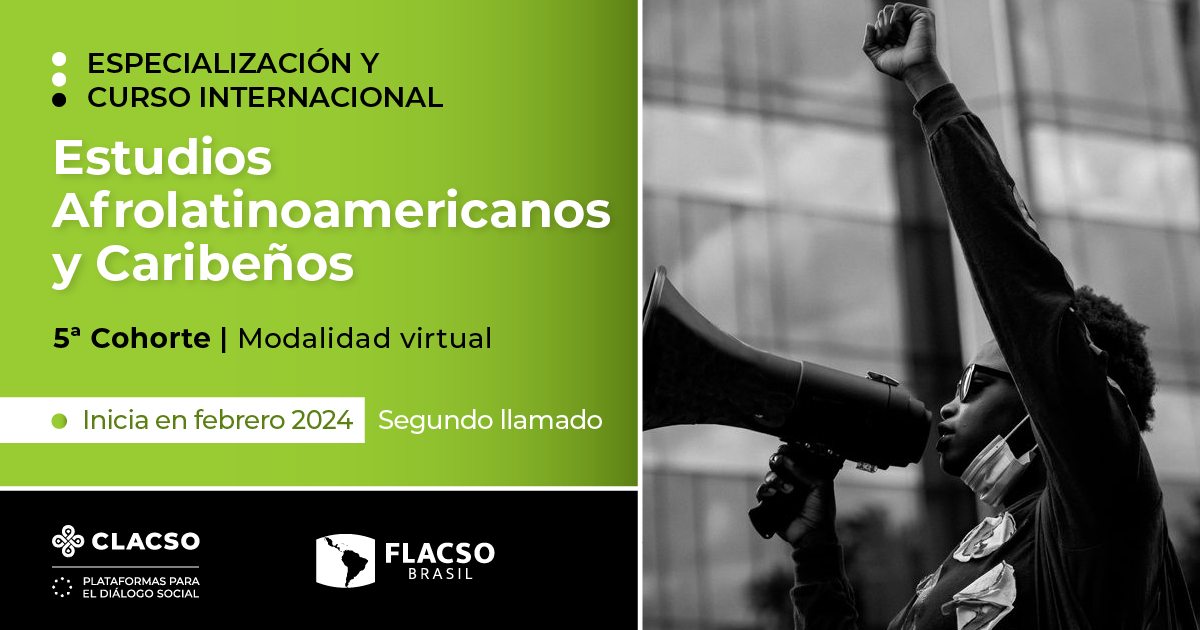

5th Cohort – Second Call | Virtual Modality (2024)
Specialization: 40 credits, 360 lecture hours
International course: 9 credits, 90 hours/lecture
Duration: February to December 2024
The certification of the Specialization and the International Course will be carried out by the Latin American Faculty of Social Sciences (Flacso Brazil) and by the Latin American Council of Social Sciences (CLACSO).
GENERAL COORDINATION
Mara Viveros Vigoya (National University of Colombia)
Nilma Gomes (Federal University of Minas Gerais, Brazil)
Rita Segato (University of Brasilia, Brazil – National University of San Martín, Argentina)
ACADEMIC COORDINATION
Karina Bidaseca (University of Buenos Aires and National University of San Martín, Argentina)
GENERAL DIRECTOR
Rita Gomes do Nascimento (FLACSO Brazil) and Karina Batthyány (CLACSO)
The Specialization and International Course in Afro-Latin American and Caribbean Studies is an intensive postgraduate training program that aims to disseminate current research and debates on the history, trajectories, and social dynamics of the Afro-descendant population of Latin America and the Caribbean from critical decolonial, Afro-Latin American, Afro-Caribbean, and Afro-feminist perspectives. It also provides a space for intertwining academic, political, educational, and aesthetic reflections and fostering the creation and strengthening of this field of study.
In Latin America and the Caribbean, coloniality is a constitutive and specific element of a power structure in which the imposition of an ethno-racial classification on its population played a key role. Becoming aware of this coloniality of power, which operates in macro-social, micro-social, and subjective spheres, requires addressing the epistemologies of Afro-America and the racial question as a colonial historical invention whose effects continue to influence the social destiny and daily lives of those who inhabit this region. In turn, recognizing power as a web of relationships that inextricably intertwines at least three systems of oppression—race, gender, and class—and the various matrices that shaped the “historical alterities” derived from racialization in each nation, implies offering a new perspective on these relationships and promoting more effective actions, based on the specificities of Afro-Latin American and Caribbean thought and creativity. Finally, it involves understanding and confronting the processes of discrimination, exclusion, criminalization, genocide, femicide, and juvenicide of Afro-descendant populations and participating in the creation of conditions for the production of their own knowledge about these processes, and of appropriate strategies to fight against these forms of violence.
Over the past decade, the region has witnessed what could be termed an anti-racist turn, a shift in how racism and its effects are addressed in the public sphere, particularly from the perspective of local anti-racist work. Simultaneously, the last two years have brought to the forefront the processes of oppression and racist violence inherent in colonialism—as evidenced by the disproportionate ethnic and racial distribution of COVID-19 victims and the global movement of protests and awareness-raising against racism sparked by police violence and the deaths of George Floyd in Minneapolis and other young people of color in various countries across the region. Furthermore, in many contexts, this movement has driven—with varying levels of intensity, scope, and results—the development and implementation of public policies to combat racism.
This training program seeks to account for the growth in the academic and political sphere of the intellectual and political organization of Black Latin Americans and Caribbeans and of an Afro-oriented theoretical and intellectual production that is investigating and confronting racism in its multiple dimensions and levels, from a critical and emancipatory perspective.
- To publicize and promote research on theories, histories, philosophies, knowledge, arts and cosmologies of African heritage in the Latin American and Caribbean continent.
- To provide conceptual and historical elements that allow for critical and intersectional approaches to addressing the racialization processes of Afro-descendant populations and their effects on social and daily life.
- Promote intersectional and situated analyses that allow understanding of the complexity of the existence of Afro-descendant women, men and LGBTIQ people and encourage the recognition of their rights.
- To train and empower for the design, monitoring and evaluation of actions and policies aimed at guaranteeing the human rights of Afro-descendant populations in the face of criminalization, genocide, femicide and black youth murder.
- Analyze the international conventions, agreements and resolutions that recognize and protect the rights of Afro populations within the framework of the Decade for People of African Descent.
The Specialization and the International Course are aimed at university graduates; postgraduate students; teachers; activists and members of trade union organizations, social movements and political parties; public officials; press workers; members and managers of non-governmental organizations and professionals interested in the study and implementation of care policies in Latin America and the Caribbean.
A university degree/undergraduate degree or equivalent is required.


The Specialization in Afro-Latin American and Caribbean Studies will last 12 months and requires the following for accreditation:
- An intensive seminar
- An international course
- Two elective virtual seminars from the curriculum
- A writing support workshop
- The preparation of a final integrative project
The Specialization accredits 360 hours/teacher of work and is certified by CLACSO and FLACSO Brazil.
The International Course can be taken independently without enrolling in the Specialization program. For students admitted in the second intake, the course will run between February and December 2023. The following is required for accreditation:
- The realization and approval of an intensive seminar corresponding to the first 5 classes of the international course.
- Once the intensive seminar is completed, the students will be enrolled in the international course and will attend the following 7 classes.
The International Course is accredited with 90 lecture hours and is certified by CLACSO and FLACSO Brazil.
Students will have the support of academic tutors who will accompany them through the different curricular areas and guide them in the completion of final projects.
CLARIFICATION: Those who enroll in the complete Specialization should not enroll in the International Course separately.
Course materials will be offered in both Spanish and Portuguese. Similarly, the course bibliography may be provided in either of the two official languages. Student contributions to discussion forums may also be in these languages. The final research paper may be written in either Spanish or Portuguese.
Intensive seminar - "Afro-Latin American and Caribbean Studies"
Summary: The intensive seminar allows those enrolled in the second call to attend the first 5 classes corresponding to the International Course "Afro-Latin American and Caribbean Studies", in which some of the main debates that have arisen from the theoretical perspective of "intersectionality" will be addressed, in different academic and research contexts.
The Black Movement will also be analyzed as a social movement, a key player in anti-racist and democratic struggles and processes of social emancipation in Latin America. In the 21st century, this movement is organized in different ways and operates in various spheres: political, social, academic, artistic, religious, and others.
The critique of political identities during the multicultural period will be presented, along with the impact of the decolonial perspective and the thought of Aníbal Quijano, with his formulation of the invention of race and his definitive attribution of historicity to the racial theme.
Finally, the concept of Africanism as a political-cultural category will be debated, allowing us to glimpse an Afro-American feminism and intersectionality as a methodological proposal of the multiple and plural processes of resistance and also of insurgent epistemologies.
Coordination: Karina Bidaseca (National University of Buenos Aires and National University of San Martín, Argentina)
“Afro-Latin American and Caribbean Studies”
Abstract: Thinking about Latin America and the Caribbean means thinking about race completely outside the framework of multiculturalism and the political identities of the globalized spectrum, which constructed the myth of “race” as ethnicity or substantivized cultural difference founded on separation. “Race” in our continent is a product of racialization of colonial origin that varies according to different national contexts. There are three main axes through which the capitalist power structure classifies people: work, sex, and race. However, it is the category of race that is the structuring center of coloniality-modernity. From this common ground, the keynote lectures will address topics related to being Afro-descendant in Latin America and the Caribbean in the fields of history, philosophy, religion, the arts, law, gender relations, politics, violence, and education, among others.
Summary : The course will address the problem of media and racism in the formation and identification of Afro-descendant populations and in the constructions of mass media in different contexts, studying the presentation of this population in news, soap operas, advertising and journalistic notes, and using social research methodologies.
Coordinator: Elbert Agostinho (Centro Federal de Educação Tecnológica Celso Suckow da Fonseca, Brazil)
Summary: This course aims to introduce the main perspectives, contributions, and debates in the study of Afro-Latin American and Caribbean music and religion. It provides a basic understanding of the development of studies on music and religions of African origin; national formations of otherness and racialization of musical genres within frameworks of culture and power; systematic analyses of music and performance; and processes of mixture and hybridization.
Coordination: Aida Bueno Sarduy (New York University – Spain/Cuba) and Luis Ferreira (UNSAM, Argentina/Uruguay)
Abstract: This seminar explores the contributions, narratives, articulations, tensions, and alternatives of Black feminisms. It addresses the diverse contributions of Black women's movements in Latin America and the Caribbean, the struggle of racialized bodies against the coloniality of power, knowledge, and gender, through dialogues that, from an intersectional perspective, propose confronting multiple oppressions. Finally, it provides tools to delve deeper, from Afro-descendant perspectives, into the voices, silences, resistances, and re-existences.
Coordination: Rosa Campoalegre Septien (CIPS, Cuba) and Claudia Miranda (Federal University of the State of Rio de Janeiro, Brazil)
Abstract: The concept of race, as a socially constructed attribute in time and space, also functions as a parameter to attribute people to the social structure. As affirmative actions arise as a strategy to combat racism and aim mainly to undermine the social structure that places Afro-descendants in disadvantaged economic and symbolic positions. This proposal is based on the epistemological approach of Afrocentricity, in which the people of Africa and the diaspora must be the center of the study of Social phenomena, therefore, are the protagonists of their own history.
Coordination: Anna Canavarro Benite (Federal University of Goiás, Brazil) and Anny Ocoró Loango (Latin American Faculty of Social Sciences, Argentina)
Summary: This workshop is a training space designed to guide the development of the final monograph for the specialization. It will support students in defining their object of analysis, translating it into a viable research problem, constructing a work plan, developing argumentative frameworks, and establishing analytical conclusions. These tasks will be carried out individually and collectively through peer exchange and with the workshop instructor, following a discussion forum format. The workshop's objective is to produce a draft of the final specialization paper. The final monograph may be written in Spanish, Portuguese, or English.

CM PlenosIf you belong to a Full Member Center of CLACSO.
CM Associates: Yes You belong to a CLACSO Associated Centre.
No linkIf you DO NOT has any of these links with CLACSO.
| Discount for payments made by 29/01 | A payment after 29/01 | Payment in 3 installments | |
| CM Plenos | $400 | $570 | USD 750 (3 x 250 USD) |
| CM Associates | $530 | $700 | USD 1020 (3 x 340 USD) |
| No link | $600 | $960 | USD 1290 (3 x 430 USD) |
In all cases, payment can be made by credit card, deposit or bank transfer.
* Residents of Argentina will pay the equivalent in Argentine pesos according to the official exchange rate of the Banco de la Nación Argentina (BNA) on the day of payment
CM PlenosIf you belong to a CLACSO Full Member Center
CM Associates: Yes You belong to a CLACSO Associated Centre
No linkIf you DO NOT has any of these links with CLACSO
| Discount for payments made by 29/01 | A payment after 29/01 | Payment in 3 installments | |
| CM Plenos | $115 | $230 | USD 315 (3 x 10⁵ USD) |
| CM Associates | $175 | $290 | USD 420 (3 x 140 USD) |
| No link | $240 | $360 | USD 540 (3 x 180 USD) |
In all cases, payment can be made by credit card, deposit or bank transfer.
* Residents of Argentina will pay the equivalent in Argentine pesos according to the official exchange rate of the Banco de la Nación Argentina (BNA) on the day of payment
The certification of the Specialization and the International Course will be carried out by the Latin American Faculty of Social Sciences (Flacso Brazil) and by the Latin American Council of Social Sciences (CLACSO).
The Specialization and the International Course are aimed at university graduates; postgraduate students; teachers; activists and members of trade union organizations, social movements and political parties; public officials; press workers; members and managers of non-governmental organizations and professionals interested in the subject.
A university degree/undergraduate degree or equivalent is required.
To participate, you need to register through the website.
Registration will be open from November 2023.
Upon completion of the registration process, you will receive a confirmation email. On the first day of the course, you will receive your login credentials for the online platform.
It is important to keep in mind that in this training program, all courses must be completed and passed according to the established schedule. It will not be possible to retake any of the credits that make up the Specialization program. Therefore, please note that the amount paid will not be refunded if you withdraw from the program. No exceptions.
Classes will be held from February to December 2024
All students will receive the necessary instructions to access classes, bibliography and discussion forums through the virtual platform.
Accessing and navigating the Virtual Learning Environment is very simple and user-friendly. In any case, a technical and academic support team will always be available to you.
You must pass the Intensive Seminar, the International Course, two (2) elective Virtual Seminars, the methodological workshop and complete the final integrative work.
All training courses must be completed and passed - without exception - in order to receive the specialist title.
To obtain the Specialization degree, you must complete a final monograph. The methodological workshop is mandatory and aims to support you in completing this final project.
You must participate in the classes and activities proposed by the teachers and complete the final monograph.
Yes, the Specialization and the International Course are certified by FLACSO Brazil and CLACSO. The specialization has a total workload of 360 hours, and the international course 90 hours. The certificate of completion will be sent digitally and is completely free of charge. The International Specialist diploma is issued by the General Secretariat of FLACSO, located in Costa Rica. The fees and procedures for issuing and sending the international diploma can be found on the FLACSO Brazil website: https://flacso.org.br/tramitacion-de-titulos-y-certificados-2/
The Specialization and the International Course are accredited by FLACSO Brazil and CLACSO. The International Specialist diploma is issued by the FLACSO General Secretariat, located in Costa Rica. Fees and procedures for issuing and sending the international diploma can be found on the FLACSO Brazil website: https://flacso.org.br/tramitacion-de-titulos-y-certificados-2/
See the table of prices and options above.
If you wish to obtain certification from FLACSO, you will need to pay an additional fee.*
* The issuance of the printed diploma, along with the academic transcript, costs USD 222,00 (two hundred twenty-two dollars). This fee includes shipping the printed and signed documents to the student's address. The procedures for issuing and shipping the international diploma can be found on the Flacso Brazil website: https://flacso.org.br/tramitacion-de-titulos-y-certificados-2/
For any other inquiries, please contact [email protected] or [email protected]
Or send a WhatsApp message to +5491138801388
For group and institutional discounts, please contact [email protected]
. . . . .
More specializations and international courses
[widget id=”glob_block_5_widget-42″]

