
Citizenship education: approaches and purposes
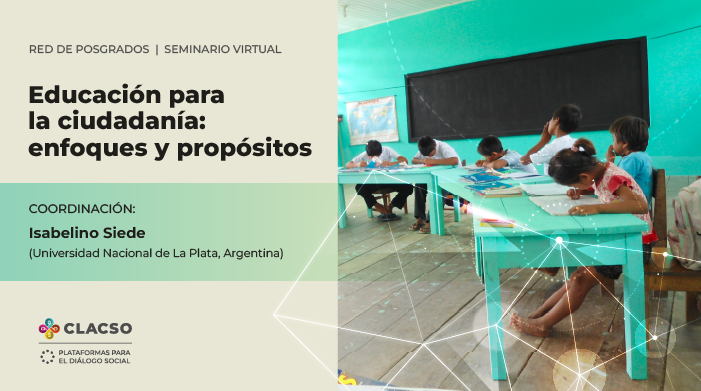
Seminar 2313
ChairCLACSO
CoordinationIsabelino Siede (National University of La Plata, Argentina)
Home: 10 / 08 / 2023 | Registration: 20/02/2023 al 09/08/2023
Workload: 12 weeks – 90 hours.
The purpose of educating citizens has been present in American educational systems since their founding mandates, as all schooling was conceived as a means of preparing for the exercise of popular sovereignty, with the limitations that this implied in each context. This long-standing presence in the school curriculum has, however, coexisted with a limited development of didactic criteria to address this particular object of instruction. As the 21st century progresses, it becomes necessary to examine what it means to educate for citizenship and what tools are useful for this task.
In the context of a social order that demands loyalty, cohesion, and adherence to the law, educating for freedom seems, on the surface, impossible. This justifies the questions we repeatedly ask ourselves from an emancipatory perspective: How do we educate a free individual? How do we educate a critical citizen? Can schools, as institutions biased by the logic of the State, teach freedom? We believe that knowledge can be a tool for freedom, but some teaching approaches foster this quality while others do not. Understanding education as a space for cultural provocation leads to the classroom becoming a realm of questions, dissent, arguments, and collective construction, where everyone feels invited to recreate the foundations of life in society.
In this seminar, we aim to review some of the curricular debates and propose some methodological alternatives for teaching. From a curricular perspective, it is relevant to analyze the connection between citizenship and other topics of contemporary debate, such as identities, human rights, and ethics, in order to clarify the purposes of citizenship education.
GENERAL PURPOSE
To critically analyze the foundations of an education for citizenship with an emancipatory perspective in the 21st century.
SPECIFIC OBJECTIVES
That the students:
- Explore the most significant historical milestones in citizenship education, in dialogue with their pedagogical foundations and social contexts.
- Discuss the challenges and demands of today's society in relation to citizenship education.
- Incorporate didactic criteria for citizenship education
- Citizenship, politics and the social function of the school
- Traditions of civic education
- Dialogue on education and citizenship in Latin America
- Citizenship and identity
- Citizenship and ethics
- Citizenship and Human Rights
- Dialogue on new challenges in political education
- Towards a situational approach to political education
- Political education and teacher positioning
- Alcain, Julia (2020). “The construction of shared problems in civic education” in Siede, Isabelino (Comp.). Towards a didactics of civic education. Teaching about discrimination in primary schools. Rosario, Homo Sapiens.
- Campillo Meseguer, Antonio (2005). “Citizenship and foreignness in the global society” in Pedreño Cánovas, Andrés and Hernández Pedreño, Manuel (coords.). The immigrant condition. Explorations and investigations from the Region of Murcia. Murcia, Publications Service of the University of Murcia.
- Campillo, Antonio (2004). “The concept of the political in global society”. Paper presented at the international meeting Proposals for new models of personal and community life. September 23 and 24, 2004, International Institute of Legal Sociology (Oñati, Gipuzkoa).
- Carretero, Mario and Kriger, Miriam (2004). “Forging patriots or educating cosmopolitans? The past and present of school history in a global world” in Carretero, Mario and Voss, James F. (Comps.). Learning and thinking about History. Buenos Aires, Amorrortu.
- Gándara Carballido, Manuel (2019). Human rights in the 21st century. A look from critical thinking. Buenos Aires, CLACSO.
- Jorquera and Radetich (2021). “Political education in Argentina. Youth participation, educational policy, teaching and contexts” in Journal of the Department of Political ScienceBogotá, National University of Colombia. No. 20 (July-December 2021).
- Kaplan, Carina and Sulca (2022). “Racism and indigenous peoples in Argentina. Challenges for school micropolitics”, in InterNations. Guadalajara, University of Guadalajara. Year 9, no. 22, January-June 2022.
- Meirieu, Philippe (2001). The choice to educate. Ethics and pedagogy. Barcelona, Octahedron.
- Nomen, Jordi (2021). “Training thinking is a way to improve the world” in Ramírez Hernández (Coord.). Topics in philosophy and education for the 21st century. Mexico, CLACSO.
- Oraisón, María Mercedes (2005). “Representations and practices of citizenship. A historical-pedagogical reading of the Argentine case” in Oraisón, Mercedes (Coord.). Building citizenship in the 21st century. Barcelona, Octahedron.
- Ruiz Silva, Alexander and Prada Londoño, Manuel (2020). The teaching of fantasy. The formation of the child as a subject of rightsBogotá, National Pedagogical University. La Carreta Publishers.
- Schujman, Andrés Gustavo Marco (2017). Dimensions of being a teacher: philosophy, education and tangoBuenos Aires, FLACSO.
- Siede, Isabelino (2007). “Towards a didactics of ethical and political training” in Schujman, Gustavo and Siede, Isabelino (Comps.). Citizenship to be built. Contributions to ethical and political education. Buenos Aires, Aique.
- Siede, Isabelino (2007). Political education. Essays on ethics and citizenship in schools. Buenos Aires, Paidós.
- Siede, Isabelino (2007): Political education. Essays on ethics and citizenship in schools. Buenos Aires, Paidós.
- Siede, Isabelino (2013). “Notes for thinking about citizenship education in the 21st Century” in Revista Reviews of History teaching. Cordoba, APEHUN. No. 11, October 2013.
- Siede, Isabelino (2020). “Current challenges of human rights education” in Olhares: Magazine of the Department of Education of Unifesp. Sao Paulo, Federal University of Sao Paulo. No. 8 (2). August 2020.
- Sousa Santos, Boaventura (2018). “The concepts we are missing” in Diario Página/12. Buenos Aires, August 20, 2018.
- Torres Carrillo (2016). Popular education and social movements in Latin America. Buenos Aires, Paidós.
- Trilla, Jaume (1994). “Active neutrality procedures” in Martínez, Miquel and Puig, Josep M. (Coords.). Moral education. Future perspectives and working techniques. Barcelona, Institute of Educational Sciences of the University of Barcelona-Graó.
- Walzer, Michael (2001). “The concept of citizenship in a changing society” in his War, politics, and morality. Barcelona, Paidós.
|
|
Discount for one payment until 09/08 |
In one payment after 09/08 |
|
CM Plenos |
$75 |
$150 |
|
CM Associates |
$95 |
$190 |
|
No link |
$95 |
$190 |
FAQ
The basic requirements for taking a seminar are:
- Availability of at least 4 hours per week to dedicate to the seminar course.
- Internet access.
- Reasonable handling of communication and computer tools.
- Language proficiency in the language in which the course will be taught. The official languages are Spanish and Portuguese.
|
|
Discount for one payment until 09/08 |
In one payment after 09/08 |
|
CM Plenos |
$75 |
$150 |
|
CM Associates |
$95 |
$190 |
|
No link |
$95 |
$190 |

