
Advanced Diploma and Update Program in Research, Transfer and Development at the Public University (ITD)
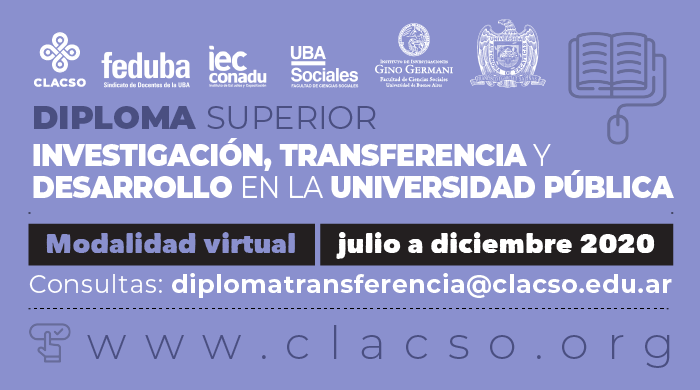
Virtual format | July to December 2020
ACADEMIC COORDINATIONOscar Galante (University of Buenos Aires, Argentina)
In times of pandemic, scientific and knowledge production institutions in general are being challenged by society as a whole. The challenge of providing an immediate response in epidemiological and technological terms arises, while at the same time the debate about the future is being revived. That is, the debate concerns development models and the role of the state in our region, where diverse perspectives intertwine, linked to the definition of the accumulation pattern, models of social inclusion, science, technology and innovation policies, educational agendas, and, of course, democratic frameworks in Latin America.
All of this is happening at a historical juncture where market logic conditions and tends to subordinate the forms of production, appropriation, and circulation of knowledge. From different theoretical frameworks and political perspectives, categories such as “post-industrial society,” “information society,” and “risk society” have highlighted the central role of science and technology in the constitution and functioning of contemporary societies. Their central idea is that new modes of scientific production can only be understood by analyzing the interaction that scientists maintain with different actors in society.
Given their public nature, their social function, their crucial importance in the current context, and their central role in the development and production of knowledge within the National Science, Technology, and Innovation Systems (SNCTI), public universities and their faculty researchers are called upon to play a leading role in this discussion. Likewise, it also calls upon and engages all professionals working in the various entities that comprise the National Science, Technology, and Innovation Systems (SNCTI) of the region's countries, as well as professionals and agents from government agencies, social organizations, labor unions, and business chambers.
The new ITD cohort, which in this edition incorporates the Autonomous University of Zacatecas (Mexico) and the support of the Gino Germani Institute of the UBA (Argentina), will focus especially on an update on the study of research, development and innovation processes in our Universities to link them in particular with the challenges posed by the COVID-19 pandemic worldwide, proposing the concrete development of innovation and transfer projects that, from the different disciplines of the students, allow contributions to address this problem in and from Latin America.
GENERAL PURPOSE
To provide tools for critical reflection on the relationship between research practice, teaching, and the social appropriation of knowledge. To develop skills for the design and management of interdisciplinary social innovation projects.
SPECIFIC OBJECTIVES
- To offer tools for reflection and analysis of knowledge production as a practice linked to the formulation and treatment of socially problematized issues.
- To help clarify and reorient the tensions that exist between the research and teaching activities carried out by university teacher-researchers.
- To provide tools for understanding how innovation works and its relationship with the social aspects of development processes.
The Higher Diploma in Research, Transfer and Development at the Public University is aimed at undergraduate and postgraduate students; teachers at all levels; activists and members of trade unions, social movements and political parties; public officials; press workers; members and managers of non-governmental organizations and professionals interested in improving their teaching practice.
Dr. Martin Unzue (University of Buenos Aires, Argentina)
Dr. Carolina Mera (University of Buenos Aires, Argentina)
Dr. René Ramírez (Former Secretary of Higher Education, Science, Technology and Innovation of Ecuador)
Dr. Jorge Aliaga (University of Buenos Aires, Argentina)
Dr. Alejandro Grimson (University of Buenos Aires, Argentina)
Dr. Dora Barrancos (Legislator of the City of Buenos Aires, Argentina)
- Roberto Salvarezza (Minister of Science, Technology and Innovation of Argentina)
- Fernando Peirano (President of the National Agency for the Promotion of Research, Argentina)
- Edgar Záyago Lau (Development Studies Unit - Autonomous University of Zacatecas, Mexico)
- Diego Hurtado (Secretary of Planning and Policies for Science, Technology and Innovation of the Ministry of Science, Technology and Innovation, Argentina)
- René Ramírez (Former Secretary of Higher Education, Science, Technology and Innovation of Ecuador)
- Carlos Bianco (National University of Quilmes, Argentina)
- Jorge Aliaga (National University of Hurlingham, Argentina)
- Martín Unzue (University of Buenos Aires, Argentina)
- Gabriela Trupia (University of Buenos Aires, Argentina)
- Ariel Gordon (University of Buenos Aires, Argentina)
- Aritz Recalde (National University of Lanús, Argentina)
- Marcela Rapallo (National University of the Arts, Argentina)
- Manuel Marí (Independent Researcher specializing in Foresight, Argentina)
- Guillermo Rus (University of Buenos Aires, Argentina)
- Eduardo Dvorkin (University of Buenos Aires, Argentina)
- Pablo Nuñez (Undersecretary of Institutional Coordination of the Ministry of Science, Technology and Innovation, Argentina)
- Oscar Galante (National University of General Sarmiento, Argentina)
- Damián Del Valle (National University of the Arts, Argentina)
The Higher Diploma consists of 8 mandatory modules, 1 elective module and 1 integrative workshop, taught consecutively and linked together.
The curriculum is organized around four thematic areas: (a) Social Studies of Science; (b) Project Planning and Management; (c) Science, Technology, Innovation and Development; (d) Integration and Production Workshop.
Total workload of 128 hours
Critical presentation of the most recognized approaches on the connections between knowledge of nature, the modalities of its production, legitimation (social and epistemological) and use, as well as the social organization of these activities and the way in which they are projected onto Argentina during the 20th century.
Professor: Diego Hurtado
Presentation of the main characteristics of the national university system in relation to research, briefly outlining its history and comparing it with other countries in the region. Introduction to the challenges of analyzing university science and technology policies linked to social innovation.
Teachers: Aritz Recalde and Martín Unzue
The production and communication of knowledge in the process of economic and social development. Policies and reflection on development. Contemporary debates on technology and development: knowledge society, risk society. Production processes in developing countries: the specificities of the Argentine case. Illustration of significant case studies in the different stages of Argentine development. The management of technological linkages and their regulatory framework. Instruments for the promotion of science and technology. The Latin American School of Science, Technology, and Development.
Professors: Oscar Galante and Ariel Gordon
Developing practical analytical skills through the presentation and discussion of innovation management processes. Science policy as public policy. The origin of the 'linear approach'. Development and institutionalization of science policy in Argentina. Research in Argentine universities. Integration of science policy within the framework of development policies: selection of scientific research priorities. Instruments for planning and managing science and technology policy. Innovation and Development Management within the university setting. Management of technological innovation. Support tools for technology and innovation management.
Professors: Jorge Aliaga, Gabriela Trupia and Roberto Salvarezza
Introduction to basic concepts of science, technology, and production. Critical reflection on the role of the State in inclusive technological development. Different approaches in the economic theory of technology. Theories of innovation. Description and analysis of the ways in which technological products are appropriated, patents, and technology transfer. Understanding technological change as an element in the development process. New technologies in their political, economic, and social dimensions.
Professors: Eduardo Dvorkin and Fernando Peirano
Within the framework of the transition from industrial capitalism to cognitive capitalism that the global accumulation system is experiencing, the course will analyze the political economy of scientific, technological and innovation production (intellectual property) experienced by the countries of the region.
• From industrial capitalism to cognitive capitalism.
• The role of STI in the productive matrix of LAC: situation and prospects.
• The global institutional framework of intellectual property in the geopolitics of international trade.
• The change in the cognitive matrix for a new social function of science.
• The topics mentioned will be addressed by analyzing the role of the State, economic actors, the University and international economic systems and their impact on the configurations of our democracies.
Professor: René Ramírez
To introduce participants to the phenomenon of "national development" based on theories of technical change, understood as the fundamental tool for achieving economic growth processes with an equitable distribution of income in a sustainable manner over time, in order to generate the social conditions in general, and economic and political conditions in particular, for the construction of fairer and more inclusive societies.
Professor: Carlos Bianco
The importance of foresight in a world of uncertainties. Foresight and planning, and their relationship.
Foresight and Technological Surveillance. Jorge Sabato, Herrera, Varsavsky, pioneers of Latin American thought on science and technology for development and also of foresight: the Bariloche model.
Professor: Manuel Marí
This course aims to generate and integrate transdisciplinary cognitive skills for the design, production, and implementation of technological artifacts and systems, and to train new social actors capable of driving processes of social inclusion, local development, and political democratization. It seeks to develop human resources with multiplier capacity—training trainers—through a broader approach to the conception, design, implementation, management, and evaluation of social inclusion strategies, based on the production and use of Technologies for Social Inclusion.
Professors: Hernan Thomas, Santiago Garrido and Facundo Picabea
This course will analyze projects focused on creation, cultural innovation, and inclusion from artistic disciplines. Given that diverse experiences of integrating research and technological development require attention to the conditions under which researchers intervene through knowledge transfer, the course offers a reflection based on successful case studies of integrating innovation projects with public and social spaces across various artistic disciplines. It will include the presentation and discussion of projects, experiences, and activities related to artistic and cultural research, creation, and innovation, showcasing different mechanisms, formats, and relationships that broaden and energize engagement options. This aims to foster the ability to formulate projects that enable fruitful collaboration between the university and its sphere of influence.
Professors: Damián Del Valle and Marcela Rapallo.
Space Activity: Beginnings, Current Status, and Perspectives. Segments of Space Activity: Communications, Earth Observation, Navigation, Space Access, and Universe Exploration. Latin America in Space: Regional Advances in the 21st Century. Regional Space Integration and Development.
Professor: Guillermo Rus
The workshop is a training space designed to guide the development of the final project for the higher diploma, incorporating the contributions from the different modules that make up the entire training course.
| Paying until 24/6 | Paying in cash (until 5/7) | Paying in 3 installments (until 5/7) | |
| CM Plenos | $100 | $200 | USD 210 (3 x USD 70) |
| CM Associates | $150 | $300 | USD 330 (3 x USD 110) |
| No link | $150 | $300 | USD 330 (3 x USD 110) |
To participate, you must register using the online form by clicking here. Registration will be open from April 30 to July 1, 2020.
Upon completion of the registration process, you will receive a confirmation in your email.
Classes will begin in July and will conclude in December 2020.
All registered participants will receive the necessary instructions to access the classes, bibliography and discussion forums through the CLACSO Virtual Training Space.
Accessing and navigating the Virtual Learning Environment is very simple and user-friendly. In any case, a technical and academic support team will always be available to you.
Yes, the advanced diploma is certified and accredited by CLACSO and the University of Buenos Aires. The diploma will be sent digitally and is completely free of charge.
| Paying until 14/6 | Paying from 15/6 | Paying in 3 installments (until 1/7) | |
| CM Plenos | $100 | $200 | USD 210 (3 x USD 70) |
| CM Associates | $150 | $300 | USD 330 (3 x USD 110) |
| No link | $150 | $300 | USD 330 (3 x USD 110) |
Payment can be made in one installment by credit card, bank deposit, or bank transfer. We also offer the option of paying in 3 installments.
Yes. There will be discounts for students belonging to CLACSO Member Centers and CLACSO Associated Centers, for CLACSO Associate Researchers, and for all those who pay before June 14, 2020.
If you are a FEDUBA member and wish to inquire about scholarships, please write to the following email address: [email protected]
Information: [email protected]
[+] Higher Diplomas
[widget id=”glob_block_5_widget-58″]

