
Advanced Diploma in Critical Theory and Marxism/s in Latin America
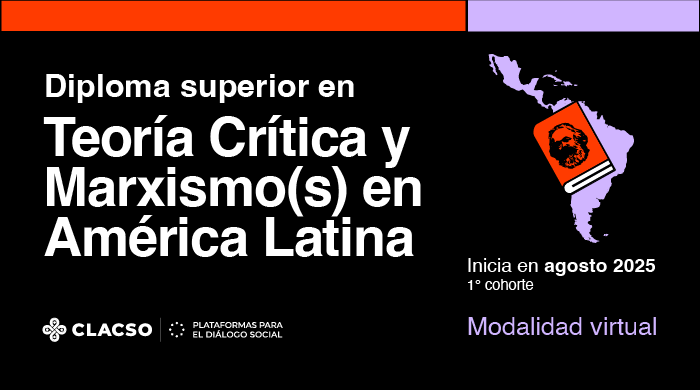
1th Cohort | Virtual Modality
ACADEMIC COORDINATION
Eduardo Grüner (UBA, Argentina)
PROFESSORS
Eduardo Grüner (UBA, Argentina); María Elisa Cevasco (USP, Brazil); Rodolfo Gomez (UBA/CLACSO, Argentina); John holloway (BUAP, Mexico); Pablo Pozzi (UBA, Argentina); Márgara Millán (UNAM, Mexico); Mabel Thwaites Rey (UBA, Argentina); Hernán Ouviña (UBA/CONICET, Argentina); Beatriz Rajland (FISYP/ UBA, Argentina) ; Carlos Rivera Lugo (UPR, Puerto Rico); Alberto Bonnet (UNQ/ UBA, Argentina); Laura Álvarez Huwiler (Argentina); Göran Therborn (UGOT, Sweden); Atilio Boron (UBA, Argentina); Eric Toussaint (CADTM, Belgium); Jorge Marchini (UBA/ FILA, Argentina); pink marques (PUC, Brazil); Mauricio Archila (UNC, Colombia); Viviana Bravo (USACH, Chile); Anahí Durand (UNMSM, Peru); Nestor Kohan (UBA, Argentina) and Nayar López (UNAM, Mexico)
Virtual format | August to November 2025
Start date : 20/08/2025 | Registration : 09/05/2025 to 19/08/2025
This Advanced Diploma aims to revisit some old, unfinished discussions—both theoretical, political, and cultural—regarding the relevance of Critical Theory and Marxism for explaining and transforming “actually existing” capitalism in Latin America, from a post-capitalist perspective. Indeed, following the shifts in social, political, and cultural power relations promoted by both civilian and military governments in the region during the 1970s and 80s, which marked the beginning of the end for the populist form of capitalism and the consolidation of a conservative neoliberal form, both Critical Theory and Marxism were sidelined as potential responses to this transformation. The broad topics we cover in this diploma course on Critical Theory and Marxism aim to make us question once again the many faces of capitalism, which in these historical moments of the 21st century - and, again, in economic, political, social and cultural terms - is once again assuming increasingly savage and expropriating characteristics.
The beginning of the 21st century in Latin America witnessed a process of crisis in the policies and governments that had been hegemonic during the 1990s. This crisis was, among other factors, the product of a resurgence of various social movements—indigenous, peasant, women's, workers', youth, etc.—in the region, which ultimately challenged this neoconservative and neoliberal hegemony.
In political terms, the critique of neoliberalism led to the arrival in government of options that generically - and in different senses - could be described as "post-neoliberal" (because some authors like Katz -2014- prefer to speak of neo-developmentalisms and others like Bonnet -2015- or Piva -2015- characterize to some extent these new governments as neo-populist), such as those of Chávez in Venezuela, Kirchner in Argentina, Lula in Brazil, Morales in Bolivia, Vázquez in Uruguay, Correa in Ecuador, among others.
However, the triumph of liberal neoconservatism worldwide during the last decade of the 20th century, coupled with the collapse of the Soviet regimes in Russia and Eastern Europe, represented not merely an economic, political, or social victory, but also a cultural one, creating a void in the utopian horizon of emancipation, from which Latin America was not exempt. Thus, once the neoconservative liberal options in Latin America entered a period of crisis and progressive options came to power, the latter focused on implementing policies that were more or less distinct from the previous neoliberal ones, but without this implying the possibility of transcending or even attempting to question the functioning of capitalism.
These limits, which capitalist functioning imposed on progressive or post-neoliberal governments, even in a political or cultural sense, precipitated the stagnation of those policies that sought to transform the dominant neoliberal paradigm and enabled the return to political power of "recharged" and radicalized neoliberal options, in such a way that, unlike the previous neo-conservative liberal options, they did not seek - nor do they seek - a horizon of democratic legitimacy.
It is in this sense that we believe it is of utmost importance—and this is what we will propose in this diploma program—to re-examine the current functioning of capitalism in Latin America from a critical perspective, where Marxist philosophies reclaim the centrality that had been displaced—politically, socially, and culturally—during the last decade of the 20th century. This is to foster a discussion about possible anti-capitalist horizons. Such a discussion is more necessary than ever in a region like Latin America, ravaged by an unprecedented neoliberal crisis, which seems to suggest that the only possible way out is a form of capitalism that currently takes the form of exceptional political regimes with neo-fascist overtones.
GENERAL PURPOSE
To raise a discussion regarding the theoretical “universe” of the so-called “Critical Theory” and Marxisms in Latin America, especially with regard to the development of its social, political and cultural critique.
Throughout this work, we will attempt to outline both the contributions this tradition has made to current "social theory," as well as the problems and theoretical challenges arising from the various dialectical perspectives that comprise this school of thought. This will be particularly true regarding the interrelationships between the "political," the "philosophical," the cognitive, and the "aesthetic," within the context of the transformations taking place in contemporary capitalist societies.
SPECIFIC OBJECTIVES
- To historicize the emergence and theoretical projection of this intellectual tradition, from the production of its authors, within the field of social sciences and in the application of the critical interpretation of Latin American reality.
- To provide students with the necessary conceptual tools to encourage a critical approach to the different theoretical-cognitive-aesthetic perspectives present in the authors who make up this tradition of critical thinking in Latin America.
- To enable students to acquire diverse critical perspectives that allow them to support a process of –in Bourdieu's terms– “epistemological vigilance” in their own productions.
- To introduce the discussion on different stages of Critical Theory and Marxisms to the present day, highlighting the importance and relevance of epistemological reflection.
- To be able to distinguish in the intellectual itinerary of this tradition of critical thought between those elements that refer to an “internal history” of theoretical evolution and its relationship with “external history”.
The Higher Diploma in Critical Theory and Marxism/s in Latin America is aimed at undergraduate and postgraduate students; teachers at all levels; activists and members of trade union organizations, social movements and political parties; public officials; members and managers of non-governmental organizations and professionals interested in the subject.
The program consists of 5 modules of 3 weekly classes each, taught consecutively and linked together.
Total workload of 128 hours.
The modules that comprise the Higher Diploma are:
Class 1: Marxism(s) and the critical theory of culture: from Latin America and beyond
Teacher: Eduardo Grüner
Class 2: The Relevance of Critical Theory and Latin American Cultural Studies
Teacher: María Elisa Cevasco
Class 3: Critical Theory, Marxisms and the current (political and cultural) role of mass media in capitalism
Teacher: Rodolfo Gómez
Class 1: Zapatismo, autonomism and Marxism: the evolution of social movements and the critical theory of capitalism
Teacher: John holloway
Class 2: The current state of the labor and workers' movement in Latin America and the anti-capitalist horizon
Teacher: Pablo Pozzi
Class 3: Feminisms and Marxisms in contemporary Latin American political and cultural reality
Teacher: Márgara Millán
Class 1: Marxisms and the critical theory of the Latin American capitalist state
Teachers: Mabel Thwaites Rey and Hernán Ouviña
Class 2: Marxism and legal critique in Latin America
Teachers: Beatriz Rajland and Carlos Rivera Lugo
Class 3: Towards a critical theory of public policies in Latin American capitalist states
Teachers: Alberto Bonnet and Laura Álvarez Huwiler
Class 1: The spaces of capital, the new imperialism and accumulation by dispossession
Teacher: David Harvey (to be confirmed)
Class 2: Marxisms, Critical Theory and the geopolitics of contemporary imperialism
Teacher: Atilio Borón
Class 3: The international financial system, external debts and current forms of Latin American dependency
Teachers: Eric Toussaint and Jorge Marchini
CLASS 1:
The case of Brazil - Teacher: Rosa Marques
The case of Peru - Teacher: Anahí Duran
CLASS 2:
The case of Colombia - Instructor: Mauricio Archila
The case of Chile - Teacher: Viviana Bravo
CLASS 3:
The case of Argentina - Teacher: Nestor Kohan
The case of Mexico - Teacher: Nayar López
| Early registration (until 04/08) | General registration (August 5th to 14th) | Registration without discount (August 15-19) | Payment in 3 installments | |
| Full or Associate Member Center | $125 | $185 | $240 | USD 315 (3 x USD 105) |
| No Link | $250 | $310 | $370 | USD 540 (3 x USD 180) |
* Residents of Argentina will pay the equivalent in Argentine pesos according to the official exchange rate of the Banco de la Nación Argentina (BNA) on the day of payment.
You must be registered in the CLACSO Single Registration System (SUIC) and enter your username and password. If you are not registered, click here . To access the registration form, click the "Register" button on the webpage of the Diploma program you are interested in.
Upon completion of the registration process, you will receive a confirmation in your email.
Classes will begin in August and will conclude in December 2025.
All registered participants will receive on the first day of activities the necessary instructions to access the classes, bibliography and discussion forums through the CLACSO Virtual Training Space.
Accessing and navigating the Virtual Learning Environment is very simple and user-friendly. In any case, a technical and academic support team will always be available. For inquiries, you can write to [email protected]
You must send an email with the request to [email protected] and we will send you the requested certificate as soon as possible.
Exceptional Criteria: In exceptional cases, and within the first 20 days of the start of the Advanced Diploma program, students may write to [email protected] requesting to withdraw and stating the reasons. After evaluation of the case, a response will be sent to the request. If approved, the student may resume the Advanced Diploma program if a new cohort is offered the following year. After this period has elapsed since the start of the course, no requests will be accepted.
Money paid will only be refunded in cases where the organizing institutions decide to cancel the activity.
Yes, the advanced diploma is certified by CLACSO. The diploma will be sent digitally and is completely free of charge.
Payment can be made in one installment, by credit card or bank transfer. We also offer the option of paying in 3 installments.
Yes. There will be discounts for students belonging to CLACSO Member Centers and CLACSO Associated Centers, for CLACSO Associate Researchers, and for all those who pay within the discount period.
You can check if you belong to a member center here:
The Advanced Diploma program integrates a dynamic of asynchronous and synchronous classes. Classes are primarily asynchronous. The schedule for synchronous sessions will be communicated by the Diploma coordinator at the beginning of the program, and participation in these sessions is not a prerequisite for passing the program.
Inquiries: WhatsApp: +54 9 11 3880 – 1388
Email: [email protected]

