
Advanced Diploma in Latin American Sociohistorical Processes
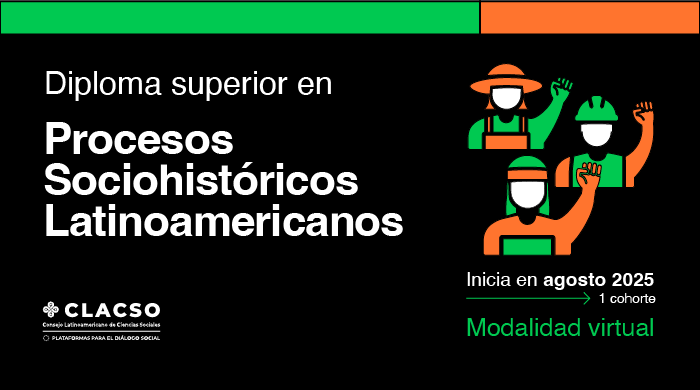
1th Cohort | Virtual Modality
ACADEMIC COORDINATION
Ana López Molina (FLACSO, Argentina), Julieta Rostica (CONICET/UBA, Argentina), Kristina Pirker (Dr. José María Luis Mora Research Institute, Mexico) and Laura Yanina Sala (UNPAZ / UBA, Argentina)
PROFESSORS
Alberto Consuegra Sanfield (UNSAM, Argentina); Alberto Martín Álvarez (University of Girona, Spain); Alejandro Flores-Aguilar (University of Edinburgh, Guatemala); Ana López Molina (FLACSO, Argentina); Carlos Figueroa Ibarra (Meritorious Autonomous University of Puebla, Mexico); Gloria Graterol (UNAM, Mexico), Juan Manuel Ledezma (UNAM, Mexico); Julieta Rostica (CONICET/UBA, Argentina); Kristina Pirker (Dr. José Maria Luis Mora Research Institute, Mexico); Laura Yanina Sala (UNPAZ / UBA, Argentina); Omar Núñez Rodríguez (UNAM, Mexico); René Villaboy (University of Havana, Cuba); Roberto García Ferreira (UDELAR, Uruguay); Rodrigo Véliz Estrada (Freie Universität Berlin, Germany); Santiago Bastos Amigo (CIESAS, Mexico) and Vanni Pettina (Università Ca' Foscari-Venezia, Italy)
Virtual format | August to November 2025
Start date : 20/08/2025 | Registration : 09/05/2025 to 19/08/2025
The Advanced Diploma addresses the social and political history of Latin America from the consolidation of nation-states to the beginning of the 21st century. It adopts an epistemological and theoretical perspective rooted in historical sociology, in which concrete historical and empirical reality is interpreted through a conceptual framework situated in time and space.
This perspective encompasses social order and change at the intersections formed by social, political, economic, and cultural structures and actions. It allows us to consider long-term history, conjunctures, and events, while also enabling us to analyze the effects of large-scale structures—such as patriarchy, racism, and class relations—and long-term processes of change in the region, understanding how the past manifests itself in the present. As a transdisciplinary framework, historical sociology allows us—following Wallerstein's (1996) suggestion—to analyze Latin American socio-political processes and to explore spatial scales.
Using a comparative methodology that focuses on the nation-state, but with an emphasis on the regional and even the "Third World," it will be easier to combine this methodology with transnational perspectives. Furthermore, thanks to faculty trained by previous generations of thinkers from the region (S. Guerra, G. Caetano, C. Naranjo Orovio, W. Ansaldi, M. Casaús, M. Quijada), Central and South America will receive balanced attention.
Postmodernity and the end of grand narratives fostered an excess of specialization and compartmentalization of knowledge, which in the field of history impacted the narrowing of geographical scales and periodizations under study. Faced with this panorama, the historian Akira Iriye, in a provocative 1989 article analyzing the American Historical Association , called for “historians from different parts of the world” to strive to “debate problems whose importance transcends local boundaries” and to translate “their respective specialized and fragmented knowledge into a more universal language” and explore its meaning. A few years later, Immanuel Wallerstein, as president of the Gulbenkian Commission, also called for “Opening Up the Social Sciences,” not only to integrate the disciplines, but to overcome the barriers that separate them, since these disciplines had become institutionalized due to the demands imposed by the consolidation of nation-states, and the nation-state no longer constituted a spatial reference point for the social problems emerging after the processes of globalization.
The Advanced Diploma program focuses on exploring historical problems that transcended the local scale from a transdisciplinary perspective, without resorting to broad generalizations. We aim to examine the past of a vast region, Latin America, which was shaped by the homogenization imposed by three centuries of colonial rule, from the moment the process of individualization and the formation of nation-states began, but always using historically relevant concepts. In this way, we avoid grand theorizations that fail to capture local specificities, but, on the other hand, we attempt to identify and highlight the similarities that allow us to develop shared explanatory hypotheses.
We seek to study major Latin American socio-historical processes, such as the formation and consolidation of nation-states, successful and unsuccessful political and social revolutions, classic populisms, institutional dictatorships of the armed forces, and the transitions to democracy that brought the Latin American Cold War to a close, analyzing them in light of key structural factors such as gender, race, and class. We believe that Latin American social and political history cannot be understood without a keen examination of patriarchy, racism, and classism.
The comparative method, which will be used to address these phenomena, offers the possibility of examining similarities and differences between national cases while simultaneously situating them within a regional context. However, the nation-state will not be the only approach; when the problem transcends the local scale, a transnational perspective will be incorporated. Throughout the program and the classes, an intentional emphasis is placed on the Central American region while maintaining a focus on South America, in order to address certain gaps and omissions in Latin American historical and sociological studies that, by neglecting the region, require revision.
The contribution of the social sciences to building a more just and equitable present and future requires a deep understanding of the foundational structures, the "historical coefficient", of our societies and of the successes and failures in attempts to transform them.
GENERAL PURPOSE
To offer an overview of Latin American socio-political history from the 19th to the 21st century from the perspective of comparative historical sociology, enabling participants in the diploma program to analyze the region in time and space, generate explanatory hypotheses, and develop a structural perspective on the region's past and present.
SPECIFIC OBJECTIVES
- To provide transdisciplinary theoretical, methodological and empirical tools for the analysis of Latin American socio-political processes.
- To address the South American and Central American regions in a balanced way.
- Promote the search for and analysis of primary historical sources.
- To achieve a deep understanding of the socio-political complexities of Latin America by destabilizing prejudices about women, indigenous and Afro-descendant populations, and gender relations.
The Higher Diploma in Latin American Sociohistorical Processes is aimed at undergraduate and postgraduate students; teachers at all levels; activists and members of trade union organizations, social movements and political parties; public officials; members and managers of non-governmental organizations and professionals interested in the subject.
The program consists of 5 modules of 3 weekly classes each, taught consecutively and linked together.
Total workload of 128 hours.
The modules that comprise the Higher Diploma are:
CLASS 1: Formation, consolidation and crisis of the nation-state in Latin America
Teachers: Gloria Graterol and Juan Manuel Ledezma
Conceptual summary of the class
The main topics of this class will be the formation, consolidation, and crisis of the Latin American oligarchic state. In addition to conceptualizing this state from the perspectives of various authors, the principal problems faced by the oligarchies in its formation will be examined. Furthermore, the conceptualization of the nation during the 19th century in Spanish America will be explored.
CLASS 2: Foundational structures: racism, nation and exclusive citizenship
Teachers: René Villaboy and Julieta Rostica
Conceptual summary of the class
This class will study the societal structures inherited from the colonial order, the hacienda and the plantation, their similarities and differences, and their geographical location. It will analyze the articulation of these social structures with the political structures that would consolidate throughout the 19th century, such as the oligarchic state, the “civilized” nation, and exclusive citizenship. It will review the forms of transition toward peripheral capitalism (the abolition of slavery and liberal reforms) vis-à-vis the forms of legitimizing those excluded from the nation and citizenship: pseudoscientific discourse, racialism, and public policies of discrimination and segregation.
CLASS 3: Sexuality and race in the founding structures of the nation
Teacher: Alejandro Flores-Aguilar
Conceptual summary of the class
This class will address the role of social imaginaries surrounding race and sexuality in shaping Latin American societies, both during the formation of nation-states and in subsequent stages. We will focus on analyzing how whiteness became a desiring construct that facilitates social mobility and serves as a key reference point in the transformation of class identities. From this perspective, we will examine the imaginaries of race, sexuality, and class—understood as reified constructs—that have been essential in molding the foundational structures of Latin America.
CLASS 1: The triumphant social revolutions: Mexico, Bolivia and Cuba
Teacher: Alberto Consuegra Sanfield
Conceptual summary of the class
In this class, using Theda Skocpol's concept of "Social Revolution," we will comparatively analyze the main social and political changes that occurred during the revolutionary processes in Mexico (1910), Bolivia (1952), and Cuba (1959). Drawing on a diverse range of sources, the class aims to analyze how these processes led to socio-class transformations in these countries, as well as their strengths and weaknesses.
CLASS 2: Frustrated social revolutions: Guatemala and Nicaragua
Teacher: Roberto García Ferreira
Conceptual summary of the class
This class analyzes the revolutions in Guatemala (1944-1954) and Nicaragua (1979-1990), which were either thwarted or failed to achieve revolutionary results, according to Charles Tilly's conceptualization. That is, the transformation of social structures (the hacienda system in Guatemala and the Somoza-era latifundia in Nicaragua) and political structures (the oligarchic state in Guatemala and the Somoza regime in Nicaragua) was halted by counterrevolutionary processes. These counterrevolutions stemmed from internal divisions, class conflicts, economic interests, and gender dynamics. But they were also largely due to external intervention and the dynamics of the Cold War in a highly transnational context. Both revolutions were also transformative in terms of gender, with women playing a key role in the struggle and in redefining social roles—issues that will be explored in the class.
CLASS 3: The “New Left” in Latin America and revolutionary projects
Teacher: Alberto Martín Álvarez
Conceptual summary of the class
The presentation reflects on what the Latin American New Left was, how and when it emerged in the region, and from which pre-existing organizations and networks. A central element in this part of the presentation will be a reflection on the historical context: why did it arise at that particular moment? This is linked to a broader, but brief, reflection—given the session's format—on some of the cumulative effects of the reconfiguration of postwar capitalism and the cultural shift on a regional and global scale.
The session will then briefly review the main organizations and groups of the New Left in each country, highlighting the basic elements of their programs and political objectives - with particular emphasis on their interpretation of the hierarchy of forms of domination (capital-labor; patriarchy; racism, etc.).
A reflection will then be opened on the strategies and forms of organization, with special emphasis on the type of relationships they established with different expressions of the popular movement (peasantry, working class, students) and the differential effects of each of these forms of linkage.
Finally, the exhibition will close with a succinct analysis of the type of relationships - cooperation, conflict, internationalist solidarity - established by the various organizations of the new left on the continent throughout different stages of their development.
CLASS 1: The concept of populism
Teacher: Carlos Figueroa Ibarra
Conceptual summary of the class
This class will revisit the conceptual content of populism as addressed by Latin American sociology from the first half of the 20th century, namely the approaches of authors such as Torcuato di Tella, Francisco Weffort, Gino Germani, Ottavio Ianni, and dependency theory. This content will be contrasted with the derogatory reconceptualization undertaken by neoliberalism in response to the rise of progressive governments in Latin America.
CLASS 2: Classical Populism
Teacher: Rodrigo Véliz Estrada
Conceptual summary of the class
This class will analyze the paradigmatic cases of populism, known as "classical populism": Mexican Cardenismo, Brazilian Vargasism, and Argentine Peronism. These movements will be studied within their historical context, including the socioeconomic conditions that gave rise to them, their ideological foundations, and the mechanisms they used to mobilize mass support. Special attention will be paid to their transnational connections, exploring whether and how these movements influenced each other through shared strategies, contacts, and alliances with neighboring countries, as well as their handling of global pressures during World War II, the Cold War, and the major economic transitions of the 20th century.
CLASS 3: The other populisms: class, ethnicity, nation.
Teacher: Omar Núñez Rodríguez
Conceptual summary of the class:
Starting with a seemingly atypical case—the relationship between Somoza's regime and the labor movement in Nicaragua—a comparative exercise will be carried out with paradigmatic experiences of populism (Argentina and Brazil) but also with less-studied cases such as El Salvador, Bolivia, and Costa Rica to address how the bourgeois-industrial worker alliance transformed the relationship with the State and expanded citizenship.
CLASS 1: The Latin American Cold War
Teacher: Vanni Pettina
Conceptual summary of the class
The course aims to offer students a reflection on the problems of conceptually defining and periodizing the Latin American Cold War. The first part of the course will attempt to define the specific characteristics of the Cold War in the Latin American region. Although initially a confrontation that arose in the heart of Europe between the United States and the USSR, as we will show students, the conflict impacted the dynamics of social, political, economic, and cultural transformation in the region, giving rise to a new historical period. The course will also discuss the problem of a periodization that, based on conceptual discussion, aligns with the classical chronology of the bipolar conflict. In a third section, the course will focus on a series of case studies that will allow for a more concrete visualization of the conclusions regarding the discussions on conceptual definitions and periodization.
CLASS 2: The military actor, US policy for Latin America and doctrinal reformulations
Teacher: Laura Sala
Conceptual summary of the class
In this class, we will examine the role of the military within the framework that characterized the Latin American Cold War. We will study the professionalization and politicization of the region's armed forces and the doctrinal reformulations stemming from the National Security Doctrine ( NSD) and the French Revolutionary War Theory. We will analyze U.S. policy toward Latin America from Kennedy's Alliance for Progress to the Reagan administration, the inter-American defense bodies, and military training programs. Finally, we will explore the gender dimension in both the identity construction of soldiers and the configuration of the political enemy: recruits in Operation Independence in Tucumán, and the "108" in Paraguay.
CLASS 3: Bureaucratic-authoritarian states, terrorist states, and institutional dictatorships of the Latin American Armed Forces
Teacher: Julieta Rostica
Conceptual summary of the class
This class reflects on the emergence of bureaucratic-authoritarian states, the characteristics of terrorist states, and the institutional dictatorships of the Armed Forces in the Southern Cone and Guatemala. It compares their forms of political power organization, the ways in which they legitimized themselves, their economic models, repressive apparatuses, the motivations of the perpetrators, and the human rights violations they committed, such as enforced disappearances and genocide. It addresses transnational networks within the Armed Forces and their articulation with far-right civilian networks in Latin America, as well as the transnationalization of the repressive apparatus and political violence, from Operation Condor to Central America. Finally, it explores the intersections of race, class, and gender in the motivations of the perpetrators and in the construction of the political enemy: recruits in Operation Independence in Tucumán, the Ixil people in Guatemala, and the "108" in Paraguay.
CLASS 1: The “long nineties”: neoliberalism and political democracy
Teacher: Kristina Pirker
Conceptual summary of the class
This session establishes the key elements that allow us to understand the multiplicity of transformations that occurred between 1979 (democratic transition in Ecuador, revolutionary transition in Nicaragua) and 2000 (alternation of parties through elections in Mexico): (1) The shift from authoritarian regimes to civilian governments; (2) the implementation of neoliberal structural reforms; (3) the impact of the end of the Cold War and the electoral defeat of Sandinismo in Nicaragua on the subjectivities and political projects of the left; and (4) the sociocultural changes that enabled the advent of a market society.
CLASS 2: Women's movements and the expansion of citizenship
Teacher: Ana López Molina
Conceptual summary of the class
In this class, we will examine how the processes of transition to democracy in Central America following the armed conflicts of the 70s and 80s gave rise to new forms of social organization, in which women's movements acquired a central role. Repression and violence blurred the boundary between the public and private spheres, driving women's participation in political and community life, whether due to the absence of men or the need to resist and organize. Furthermore, demands for better living conditions, access to land, and recognition of cultural identities broadened the scope of these movements' struggles, which in few cases identified as feminist. In this context, it is necessary to consider the role of international cooperation and the influence of organizations such as the UN in consolidating their participation in democratic construction. Through comparison with South America, we will observe the articulation of these movements around human rights and memory, advocating for justice, truth, and reparations.
CLASS 3: Indigenous movements and ethnic-racial exclusion in Latin America
Teacher: Santiago Bastos Amigo
Conceptual summary of the class
Through diverse processes associated with neoliberalism and depending on the context of each country, since the last quarter of the 20th century, Indigenous peoples began to organize themselves based on their ethnic identity to end their historical exclusion. Currently, they have become key actors in several countries and are present in virtually every one. In this class, we will examine their role in political changes and contrast it with the objectives of this movement in the region.
| Early registration (until 04/08) | General registration (August 5th to 14th) | Registration without discount (August 15-19) | Payment in 3 installments | |
| Full or Associate Member Center | $125 | $185 | $240 | USD 315 (3 x USD 105) |
| No Link | $250 | $310 | $370 | USD 540 (3 x USD 180) |
* Residents of Argentina will pay the equivalent in Argentine pesos according to the official exchange rate of the Banco de la Nación Argentina (BNA) on the day of payment.
You must be registered in the CLACSO Single Registration System (SUIC) and enter your username and password. If you are not registered, click here . To access the registration form, click the "Register" button on the webpage of the Diploma program you are interested in.
Upon completion of the registration process, you will receive a confirmation in your email.
Classes will begin in August and will conclude in December 2025.
All registered participants will receive on the first day of activities the necessary instructions to access the classes, bibliography and discussion forums through the CLACSO Virtual Training Space.
Accessing and navigating the Virtual Learning Environment is very simple and user-friendly. In any case, a technical and academic support team will always be available. For inquiries, you can write to [email protected]
You must send an email with the request to [email protected] and we will send you the requested certificate as soon as possible.
Exceptional Criteria: In exceptional cases, and within the first 20 days of the start of the Advanced Diploma program, students may write to [email protected] requesting to withdraw and stating the reasons. After evaluation of the case, a response will be sent to the request. If approved, the student may resume the Advanced Diploma program if a new cohort is offered the following year. After this period has elapsed since the start of the course, no requests will be accepted.
Money paid will only be refunded in cases where the organizing institutions decide to cancel the activity.
Yes, the advanced diploma is certified by CLACSO. The diploma will be sent digitally and is completely free of charge.
Payment can be made in one installment, by credit card or bank transfer. We also offer the option of paying in 3 installments.
Yes. There will be discounts for students belonging to CLACSO Member Centers and CLACSO Associated Centers, for CLACSO Associate Researchers, and for all those who pay within the discount period.
You can check if you belong to a member center here:
The Advanced Diploma program integrates a dynamic of asynchronous and synchronous classes. Classes are primarily asynchronous. The schedule for synchronous sessions will be communicated by the Diploma coordinator at the beginning of the program, and participation in these sessions is not a prerequisite for passing the program.
Inquiries: WhatsApp: +54 9 11 3880 – 1388
Email: [email protected]

