
Advanced Diploma in Critical Economies from the Global South
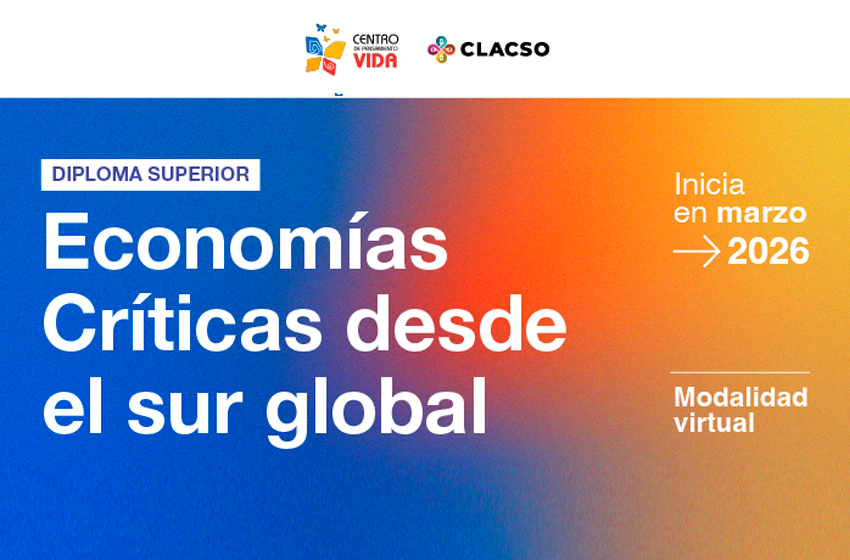
1th Cohort | Virtual Modality
The Latin American Council of Social Sciences (CLACSO) and the Center for Thought and Life invite you to participate in the Higher Diploma in Critical Economies from the global south.
ACADEMIC COORDINATION
Simon Gomez-Azza (Life Thinking Center, Colombia) | Leonardo Rodríguez Rojas (Socioeconomics, Institutions and Development Group, Colombia)
PROFESSORS
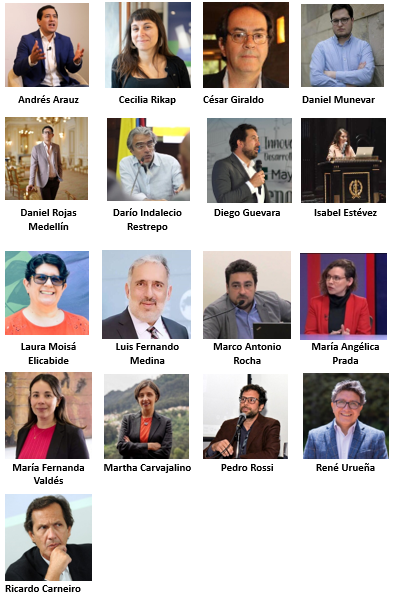
Laura Moisá Elicabide (Colombia) | Daniel Munevar (Colombia) | María Fernanda Valdés (Colombia) | Darío Indalecio Restrepo (Colombia) | Transform – Pedro Rossi y Marco Antonio Rocha (Brazil) | Diego guevara (Colombia)| Daniel Rojas Medellín (Colombia) | María Angélica Prada y Raúl Urueña (Colombia) | César Giraldo (Colombia) | Martha Carvajalino (Colombia) | Cecilia Rikap (Argentina) | andres arauz (Ecuador) | Isabel Estévez (Ecuador) | Luis Fernando Medina (Colombia) | Ricardo Carneiro (Brazil)
Virtual format | March to June 2026
Start: 04/03/2026 | Registration: 29/10/2025 to 03/03/2026
The Advanced Diploma in Critical Economies from the Global South seeks to create an academic space for reflection, debate, and advanced training on the main critical currents of economic thought emerging from countries of the Global South. From an interdisciplinary and decolonial perspective, the diploma program proposes to examine the theoretical, methodological, and political foundations that underpin contemporary economies, with the aim of contributing to the formulation of alternatives to the dominant neoliberal and extractivist model.
Over 15 weeks and through five thematic modules, participants will have the opportunity to engage in dialogue with leading academics and regional experts on topics such as critical macroeconomics, fiscal justice, structural constraints on development, territorial economies, and the prospects for an economy for life in the context of ecological and technological crisis.
The Advanced Diploma in Critical Economies from the Global South emerged as a response to the profound transformations that neoliberalism has imposed on Latin America, not only in income distribution but also in forms of ownership and the organization of production. For decades, free-market reforms concentrated wealth, weakened the state, and subordinated national economies to corporate and financial interests. In response to these effects, the diploma program offers a space for collective reflection to understand and transform the structural roots of inequality and dependency in the region.
From a critical and pluralistic perspective, the program addresses debates on the ownership of the means of production, democratic economic planning, and the need to reconfigure the productive structure toward more equitable and sustainable models. In this sense, popular, solidarity, and community-based economies are recognized as living expressions of resistance to the dominant model: forms of production and social ownership that promote cooperation, the redistribution of value, and the autonomy of territories in the face of extractive and financial capital.
Finally, the diploma program introduces an approach that allows for rethinking economics for life, reorienting national accounting systems toward human and ecological well-being, and incorporating a materialist interpretation of the economy based on energy and resource flows. This approach proposes overcoming the limitations of GDP as a measure of progress, exploring alternative methodologies and sustainability indicators that integrate ecological economics with public planning. In this way, the program aims to train professionals capable of rethinking the economy from the perspective of planetary boundaries and of guiding policies toward the sustainability of life and social justice.
GENERAL OBJECTIVES
To provide theoretical and methodological tools to rethink economies from a critical perspective, contextualized in the realities of the Global South, that articulates fiscal, territorial and socio-environmental justice, and promotes alternative proposals to the neoliberal and extractivist model.
SPECIFIC OBJECTIVES
- Strengthening the analytical capacities of participants regarding critical macroeconomic approaches and public policies oriented towards inclusive and sustainable development in the Global South.
- To promote a comprehensive understanding of fiscal, institutional, and productive systems from a redistributive, territorial, and ecological perspective, contributing to the construction of fairer and more democratic states.
- To promote the formulation of alternative proposals for economic and social organization based on territorial experiences, popular economies and approaches to economics for life, in the face of the challenges of the climate and technological crisis.
The program consists of weekly class modules, each taught consecutively and interconnected. The course combines synchronous and asynchronous learning.
Total workload of 128 hours.
The modules that comprise the advanced diploma are:
- CLASS 1: Monetary Policy and its coordination with fiscal policy
Teacher: Laura Moisa – Colombia -
CLASS 2: Debt in Latin America
Teacher: Daniel Munevar – Colombia -
CLASS 3: Financialization in emerging economies
Teacher: Ricardo Carneiro – Brazil
- CLASS 1: Tax Justice
Teacher: María Fernanda Valdés – Colombia -
CLASS 2: Decentralization and Institutional Architecture
Teacher: Darío Indalecio Restrepo – Colombia -
CLASS 3: The Role of the State in the Economy for the Democratic Transition
Teachers: Pedro Rossi and Marco Antonio Rocha – Brazil
-
CLASS 1: International constraints on a macroeconomy that favors the majority
Teacher: Diego Guevara – Colombia -
CLASS 2: Effective demand and involuntary unemployment in peripheral economies
Teacher: Daniel Rojas Medellín – Colombia -
CLASS 3: International economic law, free trade agreements and bilateral investment treaties
Teachers: María Angélica Prada, René Urueña – Colombia
-
CLASS 1: Popular Economies as an Engine of Development
Teacher: Cesar Giraldo – Colombia -
CLASS 2: Agrarian Reform, Agri-food Systems and Agroecological Transition
Teacher: Martha Carvajalino – Colombia -
CLASS 3: Democratic Planning of the Economy
Teacher: Cecilia Rikap – Argentina
-
CLASS 1: Macroeconomics and Accounting for Life
Teacher: Andrés Aráuz - Ecuador -
CLASS 2: Green and Popular Reindustrialization
Teacher: Isabel Estévez - Ecuador -
CLASS 3: Economy in the Age of Artificial Intelligence
Teacher: Luis Fernando Medina (Colombia)
| Early registration (until 16/12) | General registration (May 6th to May 25st) | Registration without discount (26/02 to 03/03) | Payment in 3 installments | |
| Full or Associate Member Center | $125 | $185 | $240 | USD 315 (3 x USD 105) |
| No Link | $250 | $310 | $370 | USD 540 (3 x USD 180) |
* Residents of Argentina will pay the equivalent in Argentine pesos according to the official exchange rate of the Banco de la Nación Argentina (BNA) on the day of payment.
Inquiries: WhatsApp: +54 9 11 3880 – 1388
Email: [email protected]

