
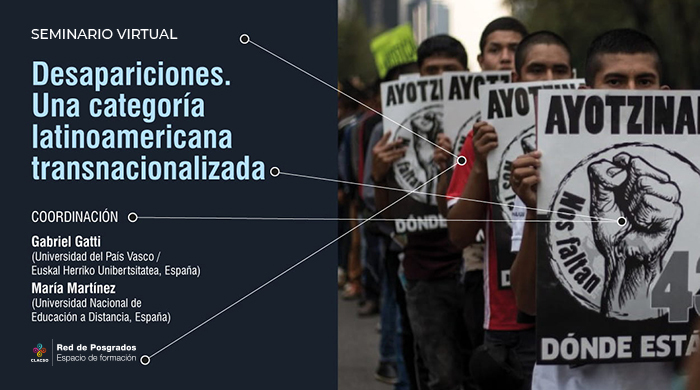
Disappearances. A transnationalized Latin American category
Seminar 2305
Chair: CLACSO
Coordination: Gabriel Gatti (University of the Basque Country, Spain) and María Martínez (National University of Distance Education, Spain)
Home: 23 / 03 / 2023 | Registration: 15/12/2022 al 22/03/2023
Workload: 12 weeks – 90 hours.
We find it everywhere: it appears when we talk about Argentina, Chile, or Uruguay in the 70s, or about Mexico or Colombia today; or if we look back and think about the Spanish Civil War or Nazi Germany in the 40s or Khmer Rouge Cambodia in the 70s or Bosnia in the war of the 90s. Or today, on the islands of Lesbos or Lampedusa, in the sea that leads to them, a Mediterranean turned into a graveyard for thousands of displaced people, fugitives, refugees; or among those called homeless, dark, invisible subjects; among the “disposable” in Colombia; and in the wide territory beyond the Melilla fence, in North Africa; or in the Arizona desert for those seeking to cross to the other side; or in the places of trafficking of women's bodies; or in the mass graves where remains lie, badly dead, in Argentina, in Libya, in Mexico. Everywhere there have been and are what we now call "serious human rights violations," it appears. There are hundreds, thousands of cases. Millions. Old and new, near and far. All are, or we call them, disappearances, as the disappeared.
The category of disappearances has indeed become a sensation, pluralized, transnationalized, and even enshrined in an International Convention. It has become normalized, accepted as fact, and continues to expand and grow, colonizing territories increasingly distant from its origins and transcending the situations in which it arose. It is no longer exclusive to dictatorships, nor does it refer solely to a strategy of eliminating the political enemy carried out by the State or paramilitary agents. This is not the case today, and it is this complexity that we want to explore by investigating territories where the category was not previously considered applicable, but where it is now being used. We argue that disappearance is the form that a world marked by catastrophe, vulnerability, and abandonment takes today, and we investigate how, paradoxically, social disappearance is inhabited (in shelters). The only thing these situations of disappearance seem to have in common, besides the name, is that they confront us with the limitations of our inherited categories and the narratives we have been using, which are now overwhelmed. Therefore, the course also seeks to investigate what and how disappearances are told and should be told (in academia, in chronicles, in art, in statistics, in cartography...).
To address this complexity, the course will feature, in addition to the coordinating professors for each session, an interdisciplinary and international panel of instructors who, through concise and focused presentations, will approach the topic of each session from different perspectives. This diverse range of perspectives will enrich the course content and foster debate among students.
GENERAL PURPOSE
To address disappearance as a total phenomenon beyond the forms that gave rise to it, investigating, at the same time, how disappearance is inhabited and how we tell stories about situations for which our inherited categories and tools are overwhelmed.
SPECIFIC OBJECTIVES
That the students:
- Learn about the process of gestation, expansion, and transnationalization of the category of disappearance.
- Understand disappearance as a (new) total phenomenon that transcends the view through the individual-citizen and pay attention to some of its current forms.
- Investigate how disappearance is experienced as a context marked by catastrophe, abandonment, and lack of protection.
- Problematize the inherited categories and tools for counting —in their dual sense of quantifying and narrating— the situations (new and old) of disappearance.
- From enforced disappearances to new disappearances
- The newly disappeared: lives untold
- To inhabit the new disappearances
- Accounting for (new) disappearances: counting, recording and mapping the invisible
- Tales of Disappearance
- Alija, RA (2021). Social disappearance in International Human Rights Law and its relationship with the right to recognition of legal personality. In D. Casado-Neira, G. Gatti, I. Irazuzta, and M. Martínez (Eds.), Social disappearance. Limits and possibilities of a tool to understand lives that do not count. Leioa: EhuPress.
- Beuret, N., & Brown, G. (2017). The walking dead: The anthropocene as a ruined earth. Science as Culture, 26(3).
- Dulitzky, A. (2021). Lessons and essays. From enforced disappearance to social disappearance. In D. Casado-Neira, G. Gatti, I. Irazuzta, and M. Martínez (Eds.), Social disappearance. Limits and possibilities of a tool to understand lives that do not count. Leioa: EhuPress.
- Fregoso, RL (2017). The living dead of Mexico. In G. Gatti (Ed.), Disappearances. Local uses, global circulations. Bogotá: Siglo del Hombre-Uniandes.
- Gatti, G. (2017). Prolegomenon. Towards a scientific concept of disappearance. In G. Gatti (Ed.), Local uses, global circulation (pp. 13-32). Bogotá: Siglo del Hombre-Uniandes.
- Gatti, G. (2020). The social disappeared: Genealogy, global circulations, and (possible) uses of a category for the bad life. Public Culture, 32(1).
- Gatti, G. (2022). Where are they? Emergency cartographies for lives fallen off the map. In Disappeared. Cartographies of abandonment. Madrid: Turner.
- Gatti, G. (2022). The story of the disappeared. In Disappeared. Cartographies of abandonment. Madrid: Turner.
- Gatti, G., Irazuzta, I. and Sáez, R. (2020). The uncounted. Overflows of the legal concept of disappearance. Athenea Digital, 20(3).
- Gatti, G., & Martínez, M. (2020). Social disappearance. Uncertain life in the Anthropoene. In R. Ramos & F. García Selgas (Eds.), Uncertainties in contemporary societies. Madrid: CIS.
- Gutierrez, M. (2022). Documenting the invisible: how data activism fills visual gaps. CEIC Papers, 2022/2.
- Haraway, D. (2019). Introduction. In Staying with the Trouble: Making Kin in the Chthulucene. Bilbao: Consonni.
- Rea, D. (2021). Disappeared is a place.
- Schindel, E., and Gatti, G. (Eds.) (2020). Social Disappearance. Explorations between Latin America and Eastern Europe. Berlin: Forum Transregionale Studien.
- Tsing, AH (2021). Introduction. In The Mushroom at the End of the World: On the Possibility of Life in the Ruins of Capitalism. Madrid: Capitán Swin.
- Varela, CI, and González, F. (2015). Trafficking of figures: “Disappeared” and “rescued” in the construction of trafficking as a public problem in Argentina. CECYP Research Notes, 26.
|
|
Discount for one payment until 13/03 |
In one payment after 13/03 |
|
CM Plenos |
$75 |
$150 |
|
CM Associates |
$95 |
$190 |
|
No link |
$95 |
$190 |
FAQ
The basic requirements for taking a seminar are:
- Availability of at least 4 hours per week to dedicate to the seminar course.
- Internet access.
- Reasonable handling of communication and computer tools.
- Language proficiency in the language in which the course will be taught. The official languages are Spanish and Portuguese.
|
|
Discount for one payment until 13/03 |
In one payment after 13/03 |
|
CM Plenos |
$75 |
$150 |
|
CM Associates |
$95 |
$190 |
|
No link |
$95 |
$190 |

