
Decolonization and Cooperation
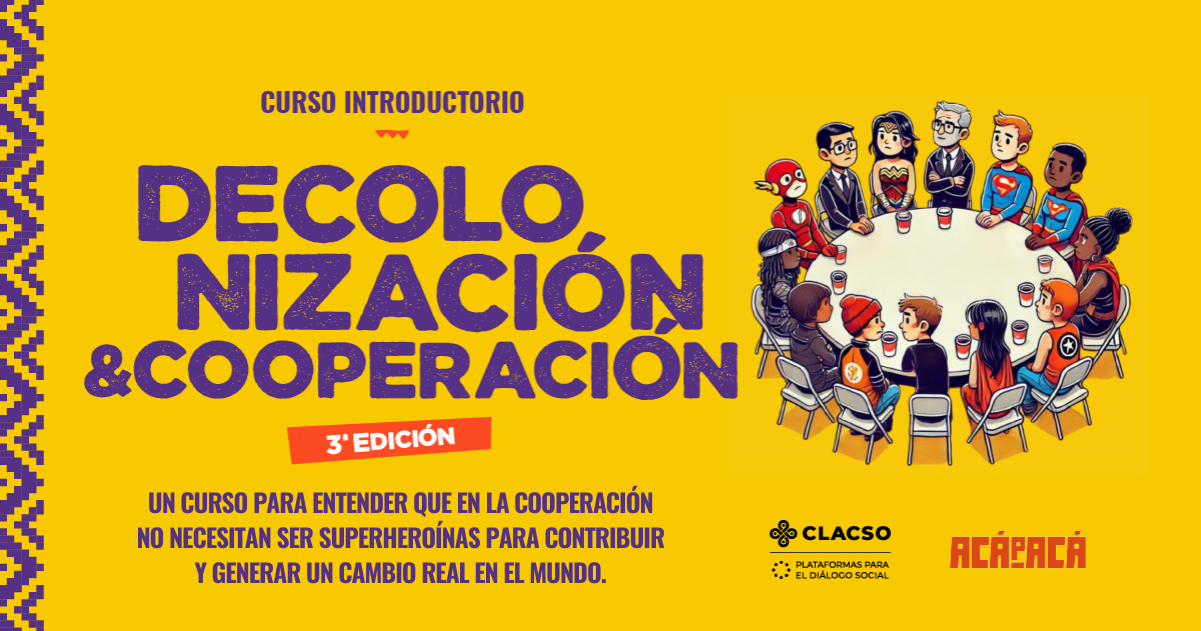

COORDINATION: Asier Hernando Malax-Echevarria (Acápacá) and Pablo Vommaro (CLACSO)
TEACHING TEAM: Karina Batthyány (CLACSO/University of the Republic, Uruguay) | Asier Hernando Malax-Echevarria (Acápacá) | Claudia Miranda (Federal University of Rio de Janeiro, Brazil) | Sergio Calundungo (Acápacá) | Adriana Anacona (University of Valle, Colombia) | Damaris Ruiz (We Effect) | Andrea Villaseñor (Hispanics in Philanthropy) | Claudia Caselli (Acápacá) | Alba Murcia (Development Hub) | Lourdes Huanca (National Federation of Peasant, Artisan, Indigenous, Native and Salaried Women of Peru) | Romel Rubén González Díaz (Abya Yala Indigenous Coordinating Coalition) | Sofía Sprechmann Sineiro (Pledge for Change)
Start: 11/03/2025
Registration: 17/01/2025 to 10/03/2025
Acápacá and CLACSO join forces to offer the third edition of the course “Decolonization and Cooperation”, a training proposal to address one of the most relevant and urgent debates in current international cooperation.
Following two successful editions with over 200 participants focused on NGOs, this third edition broadens its scope to encompass the entire international cooperation ecosystem. Our goal is to provide an understanding of the origins and fundamental concepts of the debate, along with practical tools to apply in your work. Participants will have the opportunity to learn from some of the leading thinkers in Latin America and globally who are part of the teaching team.
Decolonization is not a new concept. There has been research, debate, and action on this topic from the Global South. This issue has gained renewed visibility following the death of George Floyd and the global impact of the Black Lives Matter movement. The questioning of the Global North has drawn attention to colonial tendencies visible in all spheres, challenging the Eurocentric perspective and demanding a more equitable distribution of knowledge. However, this process cannot rely solely on critical theories from the North. Action needs to be grounded in the voices, ideas, and experiences of the Global South.
Development cooperation is deeply intertwined with colonial history. Its roots lie in the civilizing mission that accompanied colonization and perpetuate a racist logic of Western superiority. This legacy is still reflected in the terms and approaches used in the sector, such as "North-South" or "development cooperation." Therefore, rethinking cooperation from a decolonial perspective is essential for advancing toward true global justice.
Several of the world's leading NGOs and donors, such as Plan International, Care, Open Society, the Ford Foundation, Oxfam, and Doctors Without Borders, are already undertaking this process of change. They are doing so in response to the demands of the organizations they work with. It is a process that cannot be reversed.
Following the founding meeting of the Permanent Forum for the Decolonization of Cooperation, held in Lima, this course aims to strengthen the debate and foster concrete changes. Join us in this transformative process that promotes more equitable, feminist, and decolonial cooperation.
The course is designed for international cooperation professionals with both technical and managerial backgrounds. It will have a practical focus and will be delivered in eight 120-minute weekly sessions.
This training will allow you to learn about the evolution of the international cooperation sector. It will draw on the experience of social movements, academia, and NGOs to provide a broad perspective on how to advance this important agenda.
The sessions will be held on Tuesdays at the following times: 9-11am Central America-Mexico | 10am-12pm Peru-Ecuador-Colombia | 11am-13pm New York-Dominican Republic-Haiti-Cuba | 12-14pm Argentina-Brazil
Session 1: Decolonization of Power and Epistemologies of the South
Prof. Claudia Miranda
Coloniality remains a pervasive force in our social structures, perpetuating inequalities and oppression. This session delves into the need to recognize and value the epistemologies of the Global South, challenging the dominant colonial narratives in international cooperation. Through critical analysis, it reveals how structural racism and the colonial legacy continue to shape the humanitarian system. Drawing on the ideas of Aníbal Quijano and Rita Laura Segato, it analyzes the historical and current impacts of colonial power in Latin America.
Session 2: Decolonizing Cooperation: Towards an Equitable Transformation
Prof. Adriana Anacona and Alba Murcia
This class addresses the importance of decolonizing international cooperation. It explores the concepts of colonialism, coloniality, localization, and decoloniality, and their relationship to oppressive dynamics in international cooperation. A transformative approach is proposed to address these issues, aiming to build more equitable and effective relationships in international cooperation practices. Examples of resistance and the recovery of ancestral knowledge are presented, highlighting how these contributions can enrich the work of NGOs toward more equitable development.
Session 3: Programmatic Approaches and Decolonial Language
Prof. Andrea Villaseñor and Claudia Caselli
The planning developed in collaboration with partner organizations offers new perspectives and decolonial approaches to international cooperation. This course focuses on how to implement transformative programmatic planning that redefines traditional practices. It also analyzes colonial expressions still present in the sector and proposes tools for building more respectful communication aligned with decolonial principles.
Session 4: Decolonial Proposals from Social Movements
Prof. Romel González
Social movements play a crucial role in building decolonial proposals for cooperation. This session highlights the challenges civil society faces due to systemic barriers and presents the transformative agendas of social organizations. Drawing on the experience of Romel González, Coordinator of the Abya Yala Indigenous Coordinating Coalition, the session reflects on practical strategies for NGOs to adapt and contribute to the agendas of social movements and organizations.
Session 5: Feminist Perspective and Decolonial Financing
Prof. Damaris Ruiz and Sergio Calundungo
Feminist principles play a fundamental role in the decolonization of NGOs. This session addresses how to integrate feminist perspectives into fundraising and management, challenging traditional power structures. Practical examples are presented of how NGOs can adopt transformative approaches that challenge traditional power and funding structures, fostering systemic change toward more equitable cooperation.
Session 6: Resistance and Change: Donors and Governance
Prof. Sofia Sprechmann
Resistance to transforming the cooperation system is a hotly debated topic within the sector. This session analyzes internal and external resistance to change, both from organizational governance and donors. It discusses tensions and positive examples of systemic change.
Session 7: How to Change the Cooperation System: Permanent Forum for the Decolonization of Cooperation
Prof. Asier Hernando and Lourdes Huanca
This session analyzes how to collectively transform the cooperation system toward a truly decolonial approach. Using the "Permanent Forum for the Decolonization of Cooperation" initiative as an illustrative case, it delves into the commitments made and strategies implemented by various organizations to reconfigure the sector's traditional dynamics. It examines concrete progress in applying decolonial practices while reflecting on the challenges and opportunities for building a more equitable and inclusive system aligned with global demands for greater equity.

|
Latin America, Caribbean, Africa or Asia |
$185 |
|
Europe, USA, Canada or Oceania |
$215 |
Inquiries: [mail protected]

