
Agroecology and territory: knowledge, debates and methodological challenges
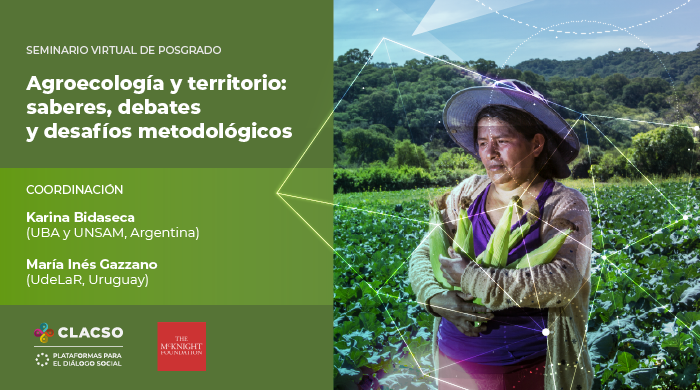
Virtual Seminar 2509
Coordination: María Inés Gazzano (Faculty of Agronomy-University of the Republic, Uruguay) and Karina Bidaseca (University of Buenos Aires and National University of San Martín, Argentina)
Teaching team: María Inés Gazzano (Faculty of Agronomy-University of the Republic, Uruguay) | Georgina Catacora Vargas (Tiahuanacu Peasant Academic Unit of the Bolivian Catholic University) | Myriam Paredes (FLACSO, Ecuador) | Manuel González de Molina (Laboratory of History of Agroecosystems, Pablo de Olavide University, Spain) | Karina Bidaseca (University of Buenos Aires and National University of San Martín, Argentina)
Start: 08/05/2025 | Registration: 28/02/2025 to 07/05/2025
Workload: 12 weeks – 90 hours.
In the current context, the capitalist world economy and modernity as a civilizational project integrate multiple structures of power and domination that transcend the economic sphere and encompass various dimensions (political, pedagogical, epistemic, economic, ecological, spatial, sexual, gender, among others). In the food sector, large corporations govern the business, driving it toward the expansion and accumulation of capital without limits and beyond the capacity of “nature.” Thus, the hegemonic food system becomes disconnected from the reproduction of societies and life, generating an unprecedented ecological and social crisis.
In this context, the agroecological approach emerges to transform power relations—both among people and with nature—at all levels where hegemony operates. Agroecology, oriented toward building sustainable, just, and equitable food systems based on the ecological management of natural resources, the conservation of biocultural diversity, and food sovereignty, weaves together multiple and diverse agroecological experiences in Latin America and the Caribbean. These experiences form the foundation upon which to amplify, deepen, synergize, and strengthen these transformations. To this end, it is necessary to engage in dialogue about what is meant by agroecology, its origins, dimensions, and principles, some of its current debates, and the central themes involved in building sustainable food and living systems, including methodological approaches to field research.
By placing life and care at the center, agroecology as a movement, science and practice allows for the possibility of a real transformation in the territories to overcome or, at least, confront this paradigm.
CLACSO brings together a range of work that has advanced the search for agroecology to be positioned on the political and academic agenda of the region. Specifically, it integrates the Working Group on Political Agroecology, the Working Group on Andean Systems, promotes the Regional Scholarship Program for Research and Training in Andean Agroecological Systems, the Communities of Practice, and the Alliance between the McKnight Foundation and CLACSO, to strengthen research and training processes for young generations of postgraduate students at Latin American universities.
This seminar aims to strengthen collective networks in the territories by contributing, through advances in agroecology, to critical thinking, learning communities, research and training processes in Latin American and Caribbean enclaves, promoting dialogue based on the transformative power of agroecology.
To this end, a series of key topics will be addressed: civilizational crisis and conceptual bases of agroecology; intersectionality and gender, ancestral knowledge and good living and peasant rights; food system and political agroecology.
People interested in rural development and the food system from different perspectives such as agronomists, sociologists, biologists, ecologists, nutritionists, economists, doctors, public policy officials, social movements, agricultural producers, farmers, press and media and activists from the environmental and agricultural sector, among others.
GENERAL PURPOSE
Reflecting on the challenges of amplifying the agroecological proposal by understanding its conceptual and methodological basis and reflecting on some central axes: agro-biodiversity, territory and peasant rights, health and food, intersectionality of struggles and gender, inter- and transdisciplinarity and political agroecology.
SPECIFIC OBJECTIVES
That the students achieve:
- Recognize the current social and ecological crisis and the characteristics of the hegemonic food system.
- Understand the conceptual foundations of agroecology, its dimensions and principles.
- Reflect on current debates, limitations and challenges for scaling up agroecology.
- Recognize inter-, transdisciplinary, participatory and action-oriented approaches to research in agroecology.
- Introduction to agroecology in a context of civilizational crisis: contributions, debates
- Research: Inter-, transdisciplinary, participatory and action-oriented reflections in agroecology
- Health and nutrition: An anthropological approach
- Good Living and ancestral knowledge
- Gender and agroecology: An intersectional and multispecies approach
- Agroecology, biodiversity and peasant rights
- Food system and political agroecology
|
|
Discount for one payment until 05/05 |
In one payment after 05/05 |
|
CM Plenos |
$85 |
$150 |
|
CM Associates |
$85 |
$150 |
|
No link |
$105 |
$190 |
FAQ
The basic requirements for taking a seminar are:
- Availability of at least 4 hours per week to dedicate to the seminar course.
- Internet access.
- Reasonable handling of communication and computer tools.
- Language proficiency in the language in which the course will be taught. The official languages are Spanish and Portuguese.
The seminars last 12 weeks, plus the completion of a final project. A total of 90 hours of dedication will be credited.
A course consists of twelve classes, each accompanied by required reading bibliography, supplementary bibliography, discussion forums and training activities proposed by the teaching team, partial deliveries and a final project.
The course is online and asynchronous. Some instructors may propose synchronous activities. In those cases, the time and date will be agreed upon beforehand between the teaching team and the students to ensure everyone's participation.
To pass the seminar, you must participate in at least 80% of the discussion forums and activities proposed by the teachers, have completed the scheduled partial deliveries, and pass the final work.
|
|
Discount for one payment until 05/05 |
In one payment after 05/05 |
|
CM Plenos |
$85 |
$150 |
|
CM Associates |
$85 |
$150 |
|
No link |
$105 |
$190 |
Inquiries: [email protected]

