
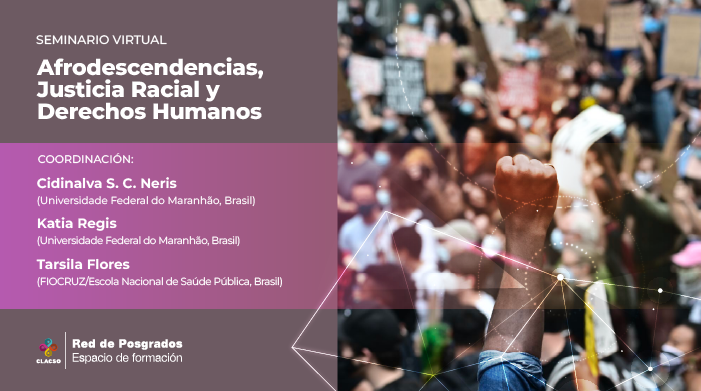
Afro-descendants, Racial Justice and Human Rights
Seminar 2304
ChairCLACSO
Coordination: Tarsila Flores (Escola Nacional de Saúde Pública, Brazil), Cidinalva Neris and Katia Regis (Universidade Federal do Maranhão, Brazil)
Teaching team: Jackeline Aparecida Ferreira Romio (Universidade de São Paulo, Brazil), Tarsila Flores (Escola Nacional de Saúde Pública, Brazil), Cidinalva Neris and Katia Regis (Universidade Federal do Maranhão), Evandro Piza (UNB, Brazil), Rodrigo Edmilson de Jesus (UFMG, Brazil),
Home: 23/03/2023 | Registration: 19/12/2022 to 22/03/2023
Workload: 12 weeks – 90 hours.
The seminar aims to present current debates and critiques based on the historical and social processes of Afro-Latin American and Caribbean communities regarding racial justice and human rights. It proposes using the lenses of intersectionality, critical criminology, and a human rights perspective to understand and confront the processes of racial and gender-based violence, discrimination, exclusion, criminalization, genocide, femicide, and the murder of young people of African descent.
The seminar is a counter-hegemonic curricular proposal that aims to create conditions for the production of emancipatory knowledge, strategies and pedagogies for interventions in necropolitical and epistemicidal contexts.
Ethnic and racial inequality constitutes a structural and structuring element of reality that affects the Afro-descendant population daily, and is a significant aspect for understanding how social inequalities and asymmetrical power relations have been historically constructed in Latin America and the Caribbean, as well as the tensions surrounding overcoming these inequities. Recognizing ethnic and racial inequality as a common feature among the countries of Latin America and the Caribbean leads us to consider the possibility of a comparative critical analysis.
This framework of inequality directly affects young people in Latin American and Caribbean countries. Focusing on the experiences, dilemmas, difficulties, and potential of young people today is also one of the challenges of this course, especially regarding access to justice and a life free from racial and gender-based violence. Intellectuals such as Abdias do Nascimento and Lélia González have long highlighted the genocide of the Black population and the precarious living conditions of young Black people, including high unemployment and police violence, which has increased significantly in recent years.
According to the IPC (Index of Crimes Against Black Youth) in Brazil, there are several challenges to curbing the murder of young Black people. On the one hand, there is an increase in "the proliferation of drug trafficking in low-income communities, especially in the favelas, which is ultimately the result of a lack of opportunities, public safety, and state negligence. In an environment where the omission of public authorities leads to the emergence of organized trafficking groups, as well as militias, the rates of violence against Black youth reach alarming levels. On the other hand, the increase in police violence against these young people is also a shocking reality. These situations involve the deaths of young Afro-descendants, especially those where the justifications for police action are based on so-called 'autos de resistance' (acts of resistance)." (CPIADJ, 2016:33)
Regarding gender violence against Afro-descendant women, the high incidence remains the same as for Afro-descendant men, especially notable is the increase in femicide of young Black women and sexual violence.
The course seeks to understand these phenomena as also connected to gaps in access to justice and the mass incarceration of the Afro-descendant population, especially young people. It will address the intersections of racism in the construction of educational, social, health, and public safety opportunities, focusing on racial and restorative justice in light of human rights through a counter-hegemonic and critical curriculum that confronts social inequalities, violence, and discrimination.
GENERAL PURPOSE
To problematize the processes of discrimination, exclusion, criminalization, genocide, femicide and juvenicide of the Afro-descendant population, as well as to reflect on the production of knowledge and strategies of emancipatory struggles against the systems of necropolitics.
SPECIFIC OBJECTIVES
- Reflecting on how social, racial, and gender inequalities are historically constituted and originated by multiple factors, and are structural in Latin American and Caribbean societies;
- To discuss the role played by social movements in Latin America and the Caribbean in the fight against inequalities and for emancipatory education.
- Discuss the impact of violence on the black population, especially in relation to genocide and black femicide in a comparative perspective in the countries of Latin America and the Caribbean;
- To discuss criminology, racial and restorative justice through the concept of intersectionality and racial critique in light of human rights principles.
- To conduct an intersectional analysis of the attributes of gender, race, and class in the distribution of punishment in criminal justice systems in Latin America and the Caribbean;
- To investigate how racism permeates the construction of the identity of young black men and women, the educational opportunities and the social experiences they live.
-
Reflecting on inequalities in Latin America and the Caribbean
Profs.: Cidinalva Neris and Kátia Regis
Synthesis of classroom concepts: In this module we intend to reflect on how social inequality is historically constituted and originated by multiple factors, and how we will discuss how the existing asymmetries in Latin American and Caribbean societies are linked to racism, machismo and inequalities.
-
Social and educational movements in Latin America and the Caribbean: forms of combating racism and social inequalities.
Profs.: Cidinalva Neris and Kátia Regis
Summary of the classroom concept: In this module we will discuss the social movements in Latin America and the Caribbean, highlighting the role they play in the fight against iniquities and for an anti-racist and emancipatory education.
-
Black femicide
Prof. Jackeline Romio
Synthesis of classroom concepts: A starting point for many academic studies on the topic is the book Femicide: the politics of woman killing, published in 1992 by Jill Radford and Diana Russel (1992). This book itself has a session dedicated to the study of the relationship between feminism and racism. In this module we will study reflections that offer fundamental concepts for the understanding of the lethal expression resulting from the interaction between the oppressions of gender, race and social class.
-
Nuances of the Black Genocide
Professor: Tarsila Flores
Synthesis of classroom concepts: It is important to discuss this topic or why it is possible to consider the homicides of young black people in Brazil and throughout Latin America and the Caribbean as a genocidal phenomenon. For this purpose, it is intended to use academic constructions on legal and socio-historical aspects, as well as the concept of “Cenas do Genocídio Negro” (FLORES, 2018). Such a concept pervades the concept of a racial dinner presented in Mbembe's work, added to the idea of a spectacular and brutal event, at the Pavis Theater. These concepts show that they are consistent with the metaphysical and phenomenological sense of the large number of deaths in the black population.
-
Relationships between concepts of feminicide and genocide
Professors. Jackeline Romio and Tarsila Flores
Synthesis of classroom concepts: The classroom addresses the relationships between the Genocide and Black Feminism phenomena and aims to provide a critical view of the quest on the concepts of race, gender and decoloniality that are at the center of the debate on the extermination of the black population. Com isso, offering critical tools does not mean the elaboration of theoretical and empirical constructions of the South, not that it says respect for the genocidal and feminicide state structures that affect all of Latin America and the Caribbean.
-
Os Discursos Científicos da Raça e da Criminalidade como Utopias de organizational do controle social - a latin-american reception of scientific racist criminological thought: Introdução ao Caso brasileiro.
Prof.: Evandro Piza
Synthesis of classroom concepts: What is the relationship between scientific discourses of race, scientific discourses on criminality and proposals for reorganization of social control? O social control as a problem for the first criminologists. The changes in the forms of social control as the end of escravidão: From captive black man to guarded freedman. Embranquecimento e Política de Immigração. Os Precursores da Criminologia Brasileira: Nina Rodrigues, o pensamento de Lombroso eo discourse sobre a mestiçagem. The importance of Positive Criminology for the diffusion of Latin American scientific racism.
-
As Judiciary Institutions in the Reproduction of Racism against a moralistic patriarchal perspective in the drug war
Prof.: Evandro Piza
Synthesis of classroom concepts: Thematic Content: How do judicial institutions reproduce sexist and racist parts in their situation? Why is the branch category essential to understand the functioning of these institutions? What are the relationships between racism and sexism in drug war policy?
-
Criminology of racial and direct relations
Professor: Dina Alves
Synthesis of classroom concepts: In Brazilian society, the category of innocence is always a racialized category, especially when it comes to the police community. If the slaves of the slaves and their relatives were considered victims of the atrocities committed by them, or heroic destroyers who sacrificed their existence in the destruction and construction of the nation, today we look at the category of victims and also thought of from a racial reading about as concepts of law and order. It is intended, through the specialized literature of criminology, the racial relations and the Direito to analyze the impact of this category and the production of official truth in judicial decisions, in the formulation of public policies of public security and in police actions.
-
But in the end, do young black people exist?
Prof.: Rodrigo Ednilson de Jesus
Conceptual Synthesis of the Classroom:
Despite the sharp social reality of racism, inequalities and violence experienced by black and Afro-descendant young people in Latin America, it is possible to observe the existence of statistical surveys, academic products and public policies that insist on ignoring the racial belonging of these young people. Understanding the production of this invisibility and debating alternatives to overcome it is one of the two objectives we first met.
-
Black youth, living conditions and school experiences
Prof.: Rodrigo Ednilson de Jesus
Conceptual Synthesis of the Classroom:
According to UNICEF, the poor living conditions and racial discrimination are some of the main barriers that young Brazilians face in order to guarantee their direction to education. The texts indicated in this section have the objective of presenting socioeconomic data of young black people in Latin America, with emphasis on inequalities in education. Understanding the close relationships between racism, living conditions and school failure is two objectives of this second encounter.
- Alves, d. (2017). Black spirits, white juices: an analysis of the intersectionality of gender, race and class in the production of punishment in a São Paulo prison. CS Magazine 21 (21), 97-120
- Alves, Racial Corpographs, pontifical Catholic University of São Paulo – puc, 2020, theses.
- Audre Lorde (poetry).need: a chorale for black woman voices”, 1990. Free translation “precise: a chorale of voices of black women”.
- Situation of Afro-descendant people in Latin America and policy challenges for guaranteeing their rights 2017.
- Combahee river collective. The combahee river collective statement. Boston, 1977.
- Duarte, EP, & Da Silva Freitas, F. (2019). Black bodies on persecution of the state: drug policy, racism and human rights in Brazil. Public right , 16 (89).
- Duarte, Evandro C. Piza; Queiroz, Marcos V. Lustosa; Costa, Pedro H. Argolo. A colonial hypothesis, a dialogue with Michel Foucault: a modernity in the black Atlantic at the center of the debate on racism and the penal system. Universitas jus, v. 27, p. 01-31, 2016.
- Feierstein, Daniel. The Genocide Convention: Some Historical and Sociological Data to Contribute to Legal Discussions. In: Journal of Criminal Law and CriminologyEconomic crimes, contraventions, constitutional guarantees, criminal procedure, execution of sentences. Year 5, No. 01. February, 2015. The law of corporations – Tucumán, Autonomous City of Buenos Aires – Argentina.
- Flowers, Tarsila. Why black genocide? In: dinners of a genocide: homicides of young black people in Brazil and the actions of state representatives. Chap. 1, p. 27 to 46. Editora Lumen Juris, Rio De Janeiro, 2018.
- Freitas, Felipe Da Silva. Black youth: what is the difference? In: diogenes pinheiro ... [et al] (orgs.). Brazilian youth agenda : readings about a decade of changes. Rio de Janeiro: unario, 2016.
- Jesus, M M De. That this world is not our cars: the construction of legal truth in criminal processes in drug trafficking. Faculty of Philosophy, Letters and Human Sciences of the University of São Paulo, 2016, theses.
- Jesus, Rodrigo Ednilson de. Efficient mechanisms in the production of school failure of black youth: stereotypes, silencing and invisibilization. Rev., belo horizon, v. 34, e167901, 2018.
- Pleyers, Geoffrey. Social movements in the 21st century : perspectives and analytical tools. Introduction and chapters 1, 8, 9 and 10. 1st ed. - Autonomous City of Buenos Aires: CLACSO, 2018. Digital book, pdf.
- Rangel, Marta; Del Popolo, Fabiana. Demographic and socioeconomic profiles: between diversity and inequality. In: Afro-descendant youth in Latin America: Diverse realities and (un)fulfilled rights. United Nations Population Fund (UNFPA).
- Santomé, Jurjo Torres. Curricular justice and the urgency of rethinking the school curriculum. Intervention in the colloquiumCurriculum – Society: Voices, Tensions and Perspectives. Mexico City, October 11, 12, 13 and 14, 2016.
- Segato, Rita Laura. “Femicide as a crime in the international human rights forum: the right to name suffering in law”. In: Fregoso, Rosa-Linda; Bejarano, Cynthia (eds.). Femicide in Latin AmericaMexico City: 2011.
- Sposito, Marília Pontes. A research on young people after graduation: a balance of student production in education, social services and social sciences (1999-2006). In: sposito, marília pontes. (coord.) The state of the art on youth in Brazilian post-graduation: education, social services and social sciences (1999-2006). Volume 1. Belo Horizonte, mg: argvmentvm, 2009.
- Walsh, Catherine. Interculturality and (de)coloniality: perspectives
|
|
Discount for one payment until 13/03 |
In one payment after 13/03 |
|
CM Plenos |
$75 |
$150 |
|
CM Associates |
$95 |
$190 |
|
No link |
$95 |
$190 |
FAQ
The basic requirements for taking a seminar are:
- Availability of at least 4 hours per week to dedicate to the seminar course.
- Internet access.
- Reasonable handling of communication and computer tools.
- Language proficiency in the language in which the course will be taught. The official languages are Spanish and Portuguese.
|
|
Discount for one payment until 13/03 |
In one payment after 13/03 |
|
CM Plenos |
$75 |
$150 |
|
CM Associates |
$95 |
$190 |
|
No link |
$95 |
$190 |

