
7th Session of the Immanuel Wallerstein Free Lecture Series with Christof Parnreiter
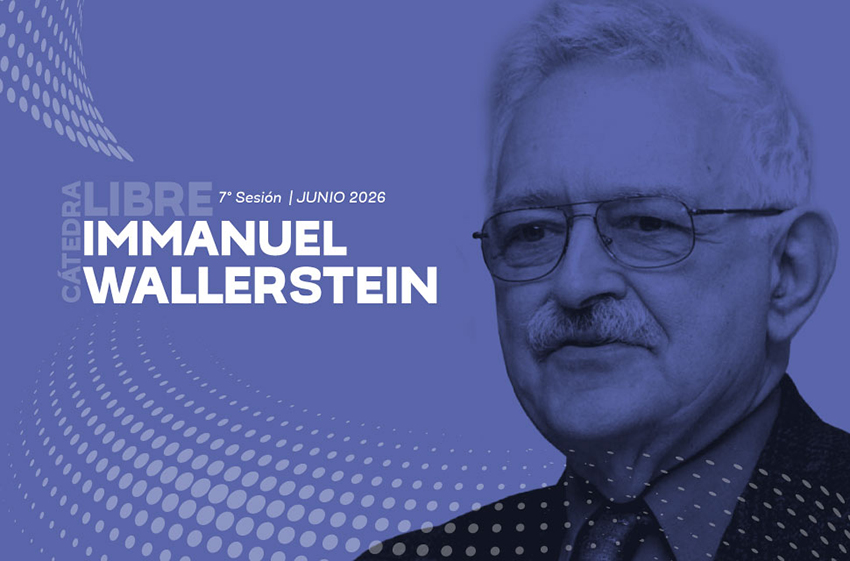
The Immanuel Wallerstein Chair, jointly organized by the CEA FCS and the Institut für Sozialforschung, invites you to the seventh session: The wealth of cities and the poverty of nations in charge of Christof Parnreiter(Universität Hamburg, Germany.)
They comment: Esteban Torres (Director, IW Chair) and Verónica Giordano (IEALC/UBA-CONICET, Argentina)
19 June 2026 Friday
In both the social sciences and international institutions, the prevailing view is that cities are a significant—if not the most important—factor in economic development. Almost without exception, the current discourse on cities is imbued with unbridled optimism: the notion that cities are indispensable engines of economic growth and social development enjoys broad consensus, transcending theoretical currents and ideological positions. Critical perspectives only emerge when urban problems such as poverty, informality, housing shortages, or segregation are addressed. Without questioning the economic potential of cities or advocating a romanticized notion of a “return to the countryside,” this conference challenges uncritical valuations of cities. The city is considered a fundamental analytical category for understanding capitalist development, which is always uneven across different scales. Cities function not only as engines of innovation and growth but also as factories of “the weapons of exploitation” (Fernand Braudel). Urban resources allow elites to create, maintain, and exploit the asymmetrical relationships that underpin the capitalist division of labor. Analyses of the world system have also largely overlooked—with few exceptions—the role of cities and their elites in the processes of centralization and peripheralization. This conference aims to address this gap by expanding on Wallerstein’s idea that the world system operates through a bifurcated geography: to the “spaces of flows” of the economy and the “spaces of territories” of politics, we must add the “spaces of density”—that is, cities—from which dominant classes exert control over other regions and populations.

Christof Parnreiter is a leading economic geographer and specialist in urban studies and globalization. With a PhD in Economic History from the University of Vienna (Austria) and a professorship at the University of Hamburg (Germany), his work is rooted in the world-systems theory tradition developed by Immanuel Wallerstein, applying it to the study of global cities and territorial inequalities. His research analyzes how large metropolises concentrate and redistribute value within the global economy, drawing on political economy, sociology, critical geography, and urbanism. Among his most influential publications are the books *The Wealth of Cities and the Poverty of Nations* (Agenda Publishing, 2024) and *Global City Makers: Economic Actors and Practices in the World City Network* (Edward Elgar Publishing, 2018). His work has had a significant impact on Latin American studies, uneven development, and contemporary globalization.

