
“Conceptualizing the Caribbean from Juan Bosch and Eric Williams: 50 years from Christopher Columbus to Fidel Castro”


CALL FOR ESSAYS
From Christopher Columbus to Fidel Castro was the title with which the prominent Caribbean intellectuals, Juan Bosch and Eric Williams, baptized their respective history of the Caribbean. Although Bosch’s book was originally conceived to be titled «The Caribbean, Imperial Border», both works were published in 1970 and titled in almost the same way: «From Christopher Columbus to Fidel Castro: The Caribbean, Imperial Border» and «From Columbus to Castro: The History of the Caribbean 1492-1969 ”.
Juan Bosch and Eric Williams share in addition to the intellectual height, the political vocation. Both were anti-colonial writers and politicians. Bosch was the first president-elect in a democracy after the Trujillo tyranny in the Dominican Republic. In September 1963, he was overthrown with a coup d’etat that gave rise to the Revolution and the United States invasion of 1965. Bosch remained active in the fight for a government of democratic, popular and emancipatory reforms for his country.
Eric Williams served as the Prime Minister of Trinidad and Tobago between 1962 and 1981. He was the first to hold this responsibility after the country’s declaration of independence in 1962. Williams had previously founded the People’s National Movement (PNM) which promoted definitively the claim for the independence of the former British colony. Already in 1944 he had published the important work “Capitalism and Slavery”, a formidable work to understand the history of colonial exploitation of the Caribbean and upon which the «prosperity» of European capitalism was built.
Bosch’s work was a watershed in the study of the Caribbean and in self-recognition of the historical role of colonies as frontiers within the empires of modernity – Spain, France, Holland, United States, United Kingdom. Williams’ work offers a historical study of the Anglophone Caribbean islands from the situation of the plantation economy and the relationships between slavery and abolition, anti-colonial movements and hegemonic colonial centers.
Both works, that of Bosch and that of Williams, are fundamental to understanding the Greater Caribbean: its history, its particularities and its conflicts. At the same time, by tracing the paths that both books have traveled over five decades, the persistence of regional fragmentation is clear to us. While Bosch’s book has been confined to the Spanish language world and has become a classic in these latitudes, Williams’ text is an obligatory reference in the anglophone and francophone space.
For these reasons, the CLACSO through the Crisis, Responses and Alternatives Working Group in the Greater Caribbean, together with the Juan Bosch Foundation of the Dominican Republic, are organizing this Call for Essays «Conceptualizing the Caribbean from Juan Bosch and Eric Williams: 50 years from Christopher Columbus to Fidel Castro”, in order to promote reflection and a critical view of these works of historical significance for the Caribbean, Latin America and the countries and territories of the Global South.
The Latin American Council of Social Sciences (CLACSO) and the Juan Bosch Foundation of the Dominican Republic invite contributions from researchers in training, that is, persons who are enrolled in a master's or doctorate program or researchers with a bachelor’s degree, although in the latter case with an upper age limit of 45 years.
Presentations of individual or collective authorship (up to three authors) that are related to the theme of this call will be accepted. The teams must respect gender parity and must select one of the members as responsible for the submission of the essay. Furthermore, each researcher may only participate with a proposal in this call.
The International committee of the call will be chaired by Suzy Castor and consist of established international experts in history and studies of the Caribbean such as Chiqui Vicioso (Dominican Republic), Félix Valdés (Cuba), Camille Chalmers (Haiti), Daniel Montañez (Spain), Pedro San Miguel (Puerto Rico), Jessica Byron (St. Kitts and Nevis), Patricia Mohammed (Trinidad and Tobago) and Humberto García Muñiz (Puerto Rico).
The call look for unpublished and original essays about the works of Eric Williams "From Columbus to Castro: The History of the Caribbean 1492-1969" (1970) and of Juan Bosch "From Christopher Columbus to Fidel Castro: the Caribbean Imperial Border ”(1970).
-
The call will be presented in a single category that awards 3 (three) prizes. The prizes will be assessed in correspondence with the quality, originality and depth in the analysis of the two mentioned works. Reflection on the impacts of both books on historical-social studies, decolonial thought and political-emancipatory processes in the Greater Caribbean region will be addressed. Likewise, analyses that address its relevance and validity for the formation and development of critical thinking, education and research, will be assessed, as well as its limitations and contributions to the construction of the cultural and intellectual identity of the Greater Caribbean.
-
The prizes consist of support for participation in a seminar in which the winning essays will be presented and the publication of these essays in a book in print and digital format, available in open access in co-edition between CLACSO and the Juan Bosch Foundation. Authors will transfer the original publication right of the works, since CLACSO adheres to and defends the principles of open science and open access to knowledge, so that what is produced is easy to find, accessible, interoperable and reusable. Subsequently, essays may be published in any other medium, always citing the original call. Applicants must inform CLACSO of the subsequent publication of the works resulting from their participation in the call.
-
The decision of the International committee will be unquestionable. It could also select among the competing essays and depending on their quality, up to 10 additional texts to be included in the compilation that includes the winning essays.
-
The essays must be between 15 and 20 pages long, written in Times New Roman font, size 12, with line spacing 1.15. Essays written in Spanish and English will be accepted. The structure of the text will be open, respecting the conventions for the presentation of an academic text and the editorial regulations of CLACSO, in addition to APA referencing style + GENDER. The essay must be an original and unpublished work and have not been previously published. Provisional versions or works published or that have obtained a local, national or international award will not be accepted.
It is an essential requirement that the presentation be made through the online registration system provided by CLACSO.
Paper or email submissions will not be accepted. Applications that do not comply with the established guidelines will be technically rejected.
It is recommended to enter the online system to know the registration format.
- Enter the CLACSO website www.clacso.org to access the registration system. Register in the CLACSO Single Registration System (SUIC). Every time the applicant wishes to enter the system to consult, modify, add or send information in this or any other CLACSO activity, they must enter with their username and personal password. Applicants presenting essays of collective authorship must designate one of the authors as responsible for the registration.
- El ensayo debe identificarse por su título y el seudónimo del solicitante / s. No se aceptarán las solicitudes cuyos seudónimos correspondan al nombre y / o apellido del solicitante / s.
- Complete the personal and academic data form and attach the curriculum vitae in free format; the digital copy of the passport, the digital copy of the highest academic degree obtained (or proof of the pending degree), and a color photograph of each applicant.
- Attach the essay respecting the characteristics established in this call.
- To end the registration to the call, you must click the CLOSE REGISTRATION button. The system will produce an electronic certificate that will serve as proof of the successful upload of your presentation. The system will only count as valid the applications that have been effectively closed.
- The application period closes on Monday, November 16, 2020.
- The results of the call will be announced at a press conference of the convening entities in February 2021 and will be published on the websites of both institutions. The winners will be contacted by email.
- Participation in the call implies acceptance of its conditions
NEW DEADLINE: December 9th, 2020
Inquiries to: [email protected]
Results
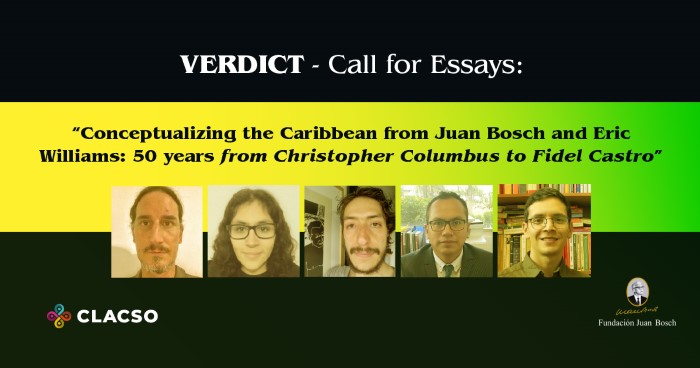
Verdict
The Latin American Council of Social Sciences (CLACSO) announces the results of the Call for essays “Conceptualizing the Caribbean from Juan Bosch and Eric Williams: 50 years from Christopher Columbus to Fidel Castro”, organized jointly with the Juan Bosch Foundation and the Crisis, Responses and Alternatives Working Group in the Greater Caribbean.
The call is part of CLACSO’s purposes of promoting reflection and critical view on Caribbean thought and the valuable contribution of its intellectuals to the social sciences and political endeavors in the region. We congratulate the young researchers who welcomed this call and submitted their essays, whose work we recognize as initial efforts on a path that we hope will be long and fruitful dedicated to the study of Caribbean issues.
All the applications received were in a condition to be evaluated by the International Committee. Said Committee considered the quality, relevance and coherence of the trials in accordance with the terms of the call.
The evaluation carried out assessed the quality of the essays presented, as well as their solvency and intellectual contribution to the problems of the call. By virtue of the quality and excellence of the majority of the works, it was decided to award 2 (two) prizes and 2 (two) mentions that will be included in the publication in printed and digital format, available in open access, in co-edition between CLACSO and the Juan Bosch Foundation.
The evaluation process was in charge of an International Committee chaired by Suzy Castor (Haiti) and integrated by prestigious experts in Caribbean History and Studies: Chiqui Vicioso (Dominican Republic), Félix Valdés (Cuba), Camille Chalmers (Haiti), Daniel Montañez (Spain), Pedro San Miguel (Puerto Rico) and Humberto García Muñiz (Puerto Rico).
Regarding to the evaluation carried out, the list of the 2 (two) award-winning essays that will be part of the publication and that will receive support for participation is presented below:
|
Researchers |
Country |
Essay title |
|
Abdiel Hernández Mendoza & Claudia Edith Serrano Solares |
México |
Williams and Bosch: two views of our Caribbean |
|
Enrique Toledo Hernández |
Puerto Rico |
Juan Bosch and Eric Williams: Epistemological Caribbeanness and Corporeal De-Ontologization |
Next, the list of the other 2 (two) essays with mention is presented, which will be recognized with their publication in the collective book:
|
Researchers |
Country |
Essay title |
|
Martín Arcila Rodríguez |
Colombia |
Secular Notes on Caribbean Psychology |
|
David Ernesto Domínguez Carbajal |
México |
The Caribbean imperial frontier, as a strategic territory in the historical geography of capitalism |
This verdict is irrevocable and unappealable.
Buenos Aires, March 19, 2021

