
Bulletin board CLACSO-CASS / Cartelera CLACSO-CASS
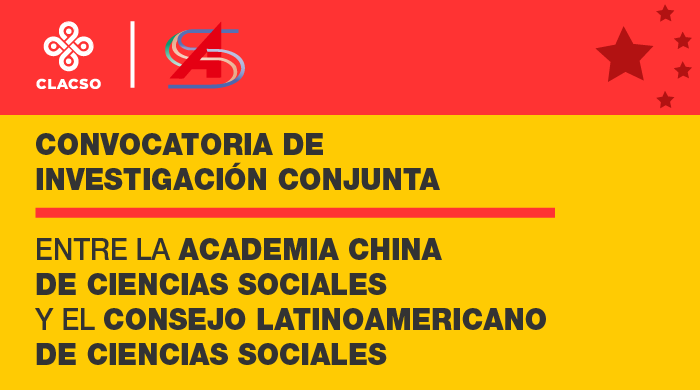
This area is proposed to broadcast and join the proposals of those interested in submitting an application in the Research program between CLACSO and CASS [See joint call]
We seek to facilitate the exchange between researchers from Latin America and the Caribbean, related to CLACSO, with researchers from institutions related to the Chinese Academy of Social Sciences (CASS).
….
Este espacio se propone para difundir y articular las propuestas de los/as interesados/as en presentar una postulación en la Convocatoria de investigación entre CLACSO y CASS. [Ver convocatoria]
Buscamos facilitar el intercambio entre investigadores/as de América Latina y el Caribe, relacionados con CLACSO, con investigadores/as de las instituciones relacionadas con la Academia China de Ciencias Sociales (CASS).
| Name and surname / Nombre y apellido: María del Carmen Evangelina Córdova Martínez |
| Research field / Tema propuesto: Pensamiento Computacional en la formación docente Summary, including Latin America and Caribbean and China exchange (max. 250 words) / Resumen del tema, incluyendo el intercambio América Latina y el Caribe y China (máximo 250 palabras): El trabajo de investigación sería sobre como desarrollar el pensamiento computacional en los jóvenes que se están formando para ser docentes de aula. Dado que en nuestra realidad no se ha desarrollado en forma óptima. Country of residence / País de residencia: Perú Institution of belonging / Institución de pertenencia: Universidad Nacional de San Agustín Institution country / País de la institución: Perú |
[email protected] |
| Name and surname / Nombre y apellido: Juan Carlos Blanco |
| Research field / Tema propuesto: environment – climate change and sustainability and its implications for human health Summary, including Latin America and Caribbean and China exchange (max. 250 words) / Resumen del tema, incluyendo el intercambio América Latina y el Caribe y China (máximo 250 palabras): We are in a civilizing crisis in which natural resources and with them, our lives are at stake and our survival is in imminent danger. More than enough reason to become aware of the danger facing the world population in the context of the climate crisis characterized by loss of biodiversity, deforestation, depletion of natural resources, contamination of drinking water, mass migrations of peoples fleeing war , hunger and desperation of social groups dispossessed of their territories or simply the absence of a decent job that allows a minimum family sustenance, are causing refugee camps in inhospitable areas and dividing walls of cultures that cause more segregation of social groups without possibilities certain resilience. Therefore, from the global south, a group of intellectuals environmental groups and human rights defenders, we are fighting for a fairer world through proposing public policies that are friendly to the environment, in favor of making economic development more compatible. balanced nations with a reduction in environmental impact, proper management of urban waste and rational use of resources, banishing the mechanisms of programmed obsolescence of goods, especially technological goods, which are causing unprecedented environmental saturation. It is in my interest to share a cooperation project in the field of environmental issues, the consequences of the climate crisis and the mitigation, adaptation and individual and collective transformation measures necessary to improve our quality of life. Both cultures, Latin American and Chinese, will be able to share knowledge with objectives of mutual scientific and technical interest and cultural complementarity. Country of residence / País de residencia: Argentina Institution of belonging / Institución de pertenencia: Member of Research group of decolonial critical thinking G-TEP – Faculty of Health Sciences and Social Work of the UNMDP Institution country / País de la institución: Universidad Nacional de Mar del Plata, Buenos Aires, Argentina |
| [email protected] |
| Name and surname / Nombre y apellido: Delfino Vargas |
| Research field / Tema propuesto: Estimating poverty and economic development at the sub-national level using night-light satellite imagery. Mexico 2022. Summary, including Latin America and Caribbean and China exchange (max. 250 words) / Resumen del tema, incluyendo el intercambio América Latina y el Caribe y China (máximo 250 palabras): The project aims to use data from night-light satellite images to carry out an analysis of poverty, informality, and gross domestic product at the sub-national level. Two data sources have been integrated to enable the scope of the project: information on economic units provided by official statistics and night-light satellite data from NASA’s Black Marble Product Suite. There is already an extensive literature that points favorably to the use of satellite night-time light data as a proxy to monitor and measure socio-economic phenomena, however, the main difficulty in using satellite data is to transform it into a user-friendly format for econometric analysis. In this sense, an important part of the project is the creation of tools and data products that facilitate the use of data from the Black Marble Product Suite. Currently, we already have a historical register of economic units at the subnational level in Mexico for the years 2012 to 2021. Also, we already have information at the locality level and the codes of branches of activity of the North American Industrial Classification System (SCIAN) as well as the number of people employed in each economic unit, which allows for a detailed level of analysis. In addition, we have information on poverty and income at the sub-national level obtained through Small Area Estimation. With this information, the project aims to estimate inequality, poverty, and GDP at the local level and thus minimize costs and obtain reliable indicators to assess Mexico’s economic development. Country of residence / País de residencia: México Institution of belonging / Institución de pertenencia: National Autonomous University of México Institution country / País de la institución: México |
[email protected] |
| Name and surname / Nombre y apellido: Héctor Arancibia |
| Research field / Tema propuesto: Migration and human mobility Summary, including Latin America and Caribbean and China exchange (max. 250 words) / Resumen del tema, incluyendo el intercambio América Latina y el Caribe y China (máximo 250 palabras): Chile is a country that has experienced mass immigration only during the current century. In fact, records suggest that more immigrants have arrived over the last decade than in the previous thirteen thousand years of known human habitation. The new great flows of immigrants come from other Latin American countries to the north, especially Venezuela, Haiti, Colombia, Peru and Bolivia. Our team has undertaken a number of studies and developed survey instruments for understanding both immigrants’ and Chileans’ experiences of migrant settlement. We would like to invite colleagues from the Chinese Academy of Social Sciences interested in comparing Latin American migration to Chile with internal migration within China, especially into cities such as Shanghai, Beijing, Shenzhen and Chongqing. We have a colleague based at Shanghai Business School and would be interested in widening our team with CASS-affiliated researchers. We speak and write English well and one member has spent time at Tsinghua and Shanghai Jiao Tong Universities. We are interested in publishing in English, Spanish and Chinese. Country of residence / País de residencia: Chile Institution of belonging / Institución de pertenencia: Instituto de Historia y Ciencias Sociales, Universidad de Valparaíso Institution country / País de la institución: Chile |
[email protected] |
| Name and surname / Nombre y apellido: Cesar Alejandro Cardona Duque |
| Research field / Tema propuesto: Migration and human mobility Summary, including Latin America and Caribbean and China exchange (max. 250 words) / Resumen del tema, incluyendo el intercambio América Latina y el Caribe y China (máximo 250 palabras): Dynamics of international migration crossing the Darien region between Colombia and Panama. Darien is a selvatic region in the border between Colombia and Panama. On both sides of the frontier there are similar social and economic conditions of poverty, inequality and presence of indigenous groups. This a region where 3 different flows cross the border on a regular basis. Those flows are related with drugs, arms and international migrants. This proposal takes a closer look at the latter. It is important to analyse the flow of migrants through the Darien region because it includes people from different nationalities such a caribbean, african and even asian countries. In this sense, to analyse and better comprehend this flow of migrants supposes a relevant topic for the improvemente of the international relations between China and latinamerican countries such as Colombia, Panama and the countries where the migrants come from. There is also a geopolítical and environmental aspect of this propposal that should be taken into account beacause the Darien region is located in the middle of the continent and has been described for centuries as a physical blockage that has hinder the conection between the North and the South of the continent. In short, this propposal aims to describe and analyze the dynamics of the international migration crossing the Darien border region. Country of residence / País de residencia: Colombia Institution of belonging / Institución de pertenencia: Corporación Universitaria Minuto de Dios Institution country / País de la institución: Colombia |
[email protected] |

